

A 10-liter listing tells you the container size, not the full terms of an order. The Caluanie Muelear Oxidize 10L container is one option among listed sizes from 1 liter through 100 liters. To compare listings, look at the stated price, delivery time, packaging and minimum order quantity together.
It’s reasonable to want a clear picture of the total order before deciding. A per-liter price and a total-container price answer different questions, and the minimum order quantity can affect what a buyer needs to purchase. This guide explains how to read product listings, compare delivery times and packaging options, and assess listed prices alongside order minimums. You’ll get a practical framework for weighing the terms side by side, without treating a container size or unit price as the whole story.
Key Takeaways
- Learn what details to compare across product listings so container size isn’t the only factor guiding an order.
- See how packaging choices and stated delivery times shape a practical purchasing comparison.
- Separate a per-liter listing price from the total container cost, and understand why minimum order quantities matter.
- Review the handling and storage information presented for the product before considering an order.
Caluanie Muelear Oxidize product listings
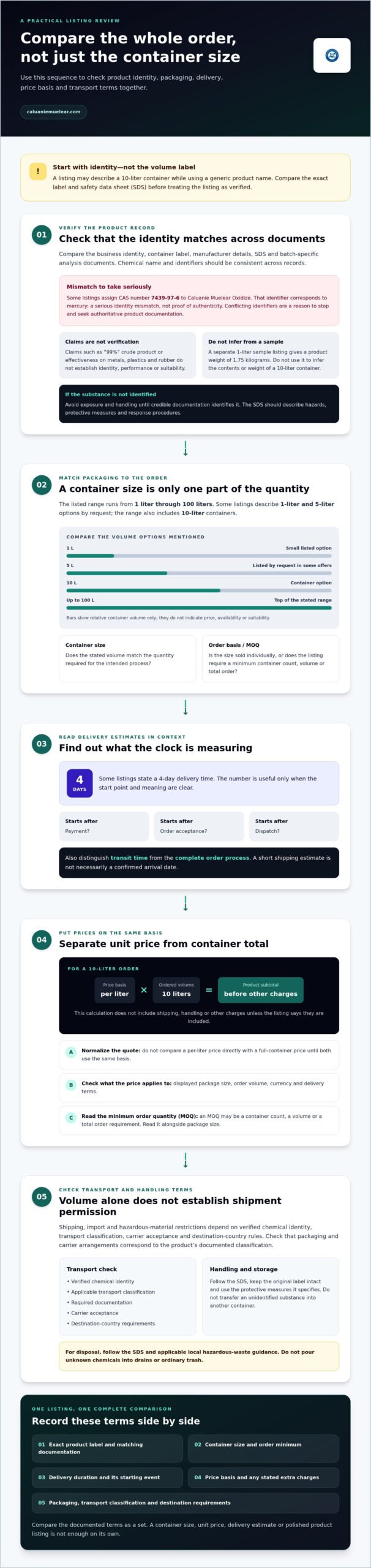
Product listings can differ in container size, identity details, and claims about intended use. A listing may describe a 10-liter container while using a generic product name, so compare the exact label and safety data sheet (SDS). Some listings assign CAS number 7439-97-6 to Caluanie Muelear Oxidize. That identifier corresponds to mercury, creating a serious identity mismatch rather than proof of authenticity. Treat conflicting identifiers as a reason to stop and seek authoritative product documentation.
Descriptions also make claims about composition and applications. For example, some state that crude Caluanie is 99% and claim effectiveness on metals, plastics, and rubber. These claims do not establish identity, performance, or suitability. A separate sample listing gives a 1-liter product weight of 1.75 kilograms. Don’t use that figure to infer the contents or weight of a 10-liter container; packaging and composition can differ.
For the claimed metal-processing or cleaning uses, consider mechanical methods or established industrial products selected for the specific material and process. Choose an alternative through its documented purpose and SDS, not promotional claims alone.
In the United States, purchase and possession requirements depend on verified composition, intended use, workplace context, and transport classification. A product name or CAS number alone cannot determine which requirements apply; use accurate product documentation to assess applicable federal, state, and local rules.
Hazards cannot be reliably assessed from a disputed listing. Avoid exposure and handling until the substance is identified through credible documentation; the SDS should describe hazards, protective measures, and response procedures.
To assess a U.S. supplier and product, compare its business identity, container label, manufacturer details, SDS, and batch-specific analysis documents. The chemical name and identifiers should match consistently across records. A polished listing or “USA-made” claim alone does not verify authenticity.
For storage and handling, follow the product’s SDS, keep its original label intact, and use the protective measures it specifies. Don’t transfer an unidentified substance into another container. For disposal, use the SDS and applicable local hazardous-waste guidance; don’t pour unknown chemicals into drains or ordinary trash.
Delivery time and packaging options
Packaging affects how much product an order contains and how it can be transported. Some listings describe 1-liter and 5-liter options available per buyer request. The seller’s product range also includes 10-liter containers, so compare the stated size with the quantity you actually need. A container size alone doesn’t explain whether a listing requires a minimum purchase or allows multiple units.
Delivery estimates need context. Some listings state a delivery time of 4 days, but that figure is useful only when you know what event starts the count. Compare whether the estimate begins after payment, order acceptance, or dispatch, and whether it refers to transit or the complete order process. These distinctions help prevent a short shipping estimate from being mistaken for a confirmed arrival date.
For a meaningful packaging comparison, record these details from each listing:
- Container size: Match the stated volume to the quantity required for the intended process.
- Order basis: Identify whether the size is sold individually or only through a minimum quantity.
- Delivery estimate: Note the stated duration and the event that starts its calculation.
- Transport details: Check that packaging and carrier arrangements correspond to the product’s documented classification.
Shipping, import, and hazardous-material restrictions depend on the verified chemical identity, applicable transport classification, carrier acceptance, and destination-country rules. A 10-liter volume does not establish that a shipment is permitted; documentation and destination requirements govern the assessment.
Listings also advise using professional logistics for transport. That matters because a chemical shipment requires suitable handling and accurate transport information, not just a container and delivery estimate. Before comparing offers, keep the packaging size, stated delivery period, order quantity, and transport terms together. This makes differences visible without assuming that similar-looking listings have identical arrangements.
For a size-based comparison, review the available container options alongside the delivery terms and product documentation.
A 10-liter container is not automatically eligible for shipment: permission depends on the verified chemical identity and transport classification, required documentation, carrier acceptance, and destination-country rules. Use professional logistics and confirm those requirements before arranging transport.
Listed prices and minimum order quantities
A listed unit price and a container’s total price describe different things. Compare the price basis first: per liter, per container, or per order. For a 10-liter purchase, a per-liter figure must be multiplied by the ordered volume to estimate the product subtotal. That calculation does not include shipping, handling, or other charges unless the listing says they are included.
Keep the unit consistent across listings. A price quoted per liter cannot be compared directly with a price quoted for a full container until both are expressed on the same basis. Check whether the price applies to the displayed packaging size, whether it changes with order volume, and whether the currency and delivery terms match. A low-looking unit figure may not represent the final amount payable.
Minimum order quantity (MOQ) sets the smallest purchase a listing accepts. It may be stated as a container count, a volume, or a total order requirement. Read it alongside the package size: an MOQ of multiple containers has a different effect from a minimum volume that can be met through smaller packages. Don’t assume the displayed size is also the minimum order.
Use a comparison table before deciding:
- Price basis: Record whether the figure applies per liter, container, or order.
- Package size: Match the quoted price to the stated volume.
- MOQ: Note the minimum volume or container quantity required.
- Order total: Separate product subtotal from listed transport or handling charges.
For example, compare a 10-liter package with smaller containers by calculating the equivalent cost per liter, then apply each listing’s MOQ. This reveals whether a lower unit price requires buying more product than the intended job needs. The most useful comparison is the complete order amount for the required quantity, with the same currency and delivery basis throughout.
Keep the calculation tied to the exact listing. Packaging, order thresholds, and included charges determine whether a quoted figure is a practical comparison or only a headline rate.
What are the ingredients and safety data for Caluanie Muelear Oxidize?
Some product descriptions call Caluanie Muelear Oxidize a light-brown, viscous liquid. They describe it as derived through trans-esterification of crude palm solution. That description is not a complete ingredient list or a substitute for a product-specific safety data sheet (SDS). Treat appearance and promotional wording as claims, not as chemical identification. The SDS should match the product name and container documentation.
Before handling any chemical, read its SDS and follow the precautions it gives. The available listing advises storing the material in a cool, dry, well-ventilated area, away from flammable substances and reducing agents. It also advises keeping containers tightly sealed and corrosion-resistant. Check the container condition regularly for leaks or deterioration, and keep its label readable.
- Identity: Compare the product name and composition details across the label and SDS.
- Storage: Use the stated cool, dry, ventilated location, separated from the listed incompatible materials.
- Container: Keep it tightly sealed in corrosion-resistant packaging and inspect for damage.
- Handling: Use the appropriate personal protective equipment specified by the SDS.
Personal protective equipment (PPE) must follow the product’s hazard information, not guesswork based on color or thickness. If the label and SDS describe different products, don’t handle or transfer the contents. Keep the container closed and isolated from routine work until its identity and precautions are resolved through suitable documentation.
For storage, handling, or transport, use the product-specific SDS rather than a generic description. Disposal instructions also need to match the identified material and applicable local waste procedures. Don’t pour unidentified chemicals into drains or discard them with ordinary waste. A product description alone cannot establish safe disposal requirements.
Review the product information alongside the SDS before making a purchasing decision.
The listing describes the Caluanie chemical product as a light-brown viscous liquid derived from trans-esterification of crude palm solution; that wording remains a description, not a verified composition. The listing also advises using appropriate personal protective equipment when handling Caluanie Muelear Oxidize. Since no ingredient percentages or hazard classifications are supplied here, do not infer them from the stated appearance or origin. Obtain documentation that identifies the specific contents and follow its handling directions before use.
Caluanie Muelear Supplier: Caluanie Muelear 1 Liter
Caluanie Muelear Supplier offers several container sizes for buyers comparing quantities against their operational needs. The range includes Caluanie Muelear 1 Liter, Caluanie Muelear Oxidize 1.5Liters, Caluanie Muelear Oxidize 10Liters, and Caluanie Muelear Oxidize 100Liters. These options give buyers distinct volumes to consider when choosing an order size.
If a 10-liter format fits your planned requirement, review its product information alongside the listing and safety documentation discussed above. For a smaller or larger volume, compare the corresponding size rather than assuming packaging or order terms are identical. Select based on the quantity your work requires and the documentation relevant to that product.
For product information or purchasing inquiries, contact Caluanie Muelear Supplier.
Choose the Next Step with Confidence
Before placing an order, match the container size to the quantity your work requires and keep product documentation aligned with that choice. A Caluanie Muelear Oxidize 10L container may suit a different purchasing plan than a smaller package, so make the decision around your actual requirements rather than volume alone.
Caluanie Muelear Supplier offers Caluanie Muelear 1 Liter, Caluanie Muelear Oxidize 1.5Liters, and Caluanie Muelear Oxidize 10Liters. Compare the relevant product information with your intended order, then choose the option that fits your purchasing needs. Clear, consistent product details make the next step more straightforward.
For questions about these options or to discuss an order, contact Caluanie Muelear Supplier. Take the time to choose carefully, then move forward with confidence.
Frequently Asked Questions
What is Caluanie Muelear Oxidize and what is it used for?
Caluanie Muelear Oxidize is marketed as an industrial oxidizing chemical for processing applications. Product descriptions claim uses in metal refining, crushing, and industrial cleaning, but promotional claims alone don’t establish a product’s identity or suitability. Before considering any use, compare the container label with product-specific documentation, including its safety data sheet. Don’t rely on a name or claimed application as proof of composition.
What is the typical price of a 10L container of Caluanie Muelear Oxidize in the United States?
Treat this as the stated product range, not an industry-wide average or a guaranteed final order total. The amount shown for an individual order can depend on the selected listing and its stated terms. Compare the exact container size and price basis before making a purchasing decision.
 English
 ភាសាខ្មែរ
 Русский
 Tiếng Việt
 한국어
 简体中文
 Қазақ тілі
 ქართული
 日本語
 Deutsch (Sie)
 O‘zbekcha
 Bahasa Melayu
 ພາສາລາວ
Свежие комментарии