
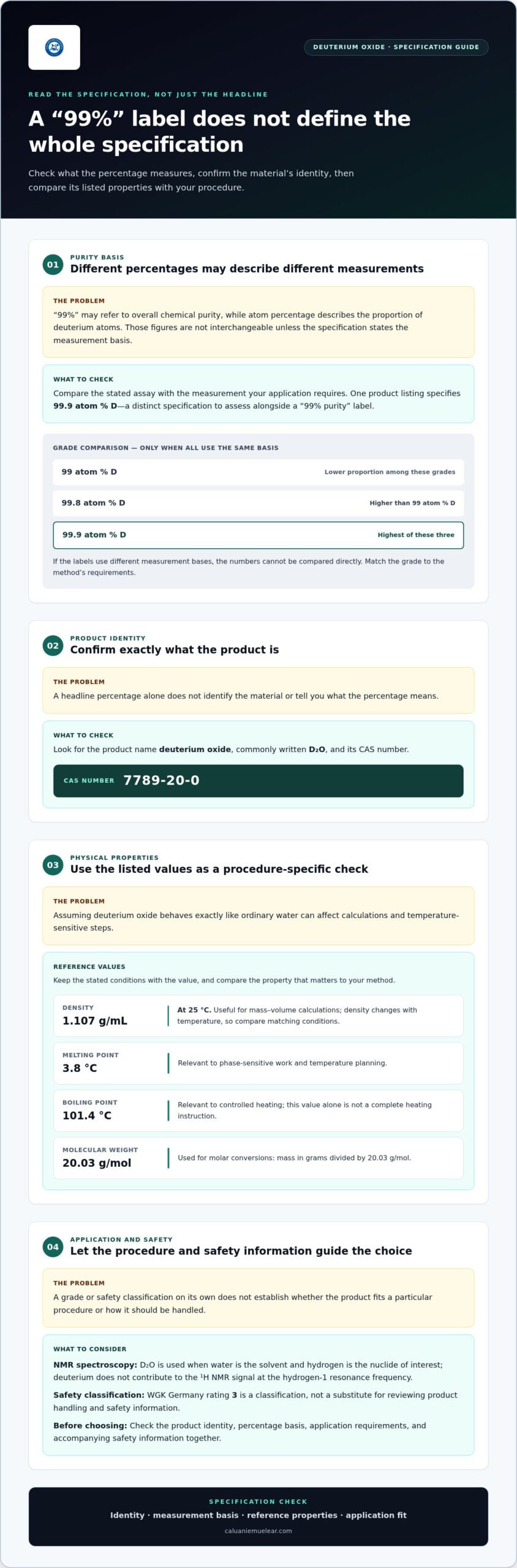
A “99%” label isn’t the whole specification. Before you buy deuterium oxide 99%, distinguish the stated purity from atom percentage: a product listing specifies 99.9 atom % D, and the compound’s CAS number is 7789-20-0. Those details help identify what the label describes, rather than relying on a headline percentage alone.
Purity matters, but choosing deuterium oxide also means confirming the product’s identity and whether its physical properties fit your intended use. Specifications that appear similar can still differ in ways that matter for an application.
This guide explains how to interpret purity and atom percentage, identify deuterium oxide by name and CAS number, and understand listed density, melting point, boiling point, molecular weight, and safety classification. It also covers uses and selection considerations to help you assess specifications before deciding what to buy.
Key Takeaways
- Compare the stated purity with atom percentage: a product listing specifies 99.9 atom % D, a distinct specification to assess alongside a “99%” label.
- Use CAS number 7789-20-0 to identify deuterium oxide and distinguish it from other materials.
- Compare reference properties with your application: density is 1.107 g/mL at 25 °C, melting point is 3.8 °C, boiling point is 101.4 °C, and molecular weight is 20.03 g/mol.
- Interpret WGK Germany rating 3 as a safety classification, not a substitute for reviewing the product’s handling and safety information.
- Consider the application when evaluating specifications; deuterium oxide is used in NMR spectroscopy when water is the solvent and hydrogen is the nuclide of interest.
Deuterium oxide purity
Purity labels need careful reading because “99%” and atom percentage can describe different measurements. Deuterium oxide, commonly written D₂O, contains deuterium instead of ordinary hydrogen in its water molecules. A percentage may describe overall chemical purity or the proportion of deuterium atoms. Those figures are not interchangeable unless the specification states the measurement basis.
To buy deuterium oxide 99%, compare the product’s stated assay with the measurement your application requires. A product listing specifies 99.9 atom % D. That value describes deuterium’s share of the hydrogen-isotope population, not necessarily the same thing as a general “99% purity” label. Check the specification wording, product identity, and accompanying safety information together.
How do 99%, 99.8%, and 99.9% grades compare? If each percentage means atom % D, 99.9 represents a higher deuterium proportion than 99.8 or 99. If the labels use different measurement bases, the numbers cannot be compared directly. Match the grade to the method’s requirements rather than treating every percentage as a single scale.
Common uses help define the needed grade. Deuterium oxide is used in NMR spectroscopy when water is the solvent and hydrogen is the nuclide of interest, because deuterium does not contribute to the ¹H NMR signal at the hydrogen-1 resonance frequency. The U.S. Environmental Protection Agency also describes its use in catalytic hydrogen/deuterium exchange to deuterate terminal and internal olefins. Select specifications according to the analytical or chemical procedure.
Which suppliers sell 99% D₂O to individuals, not just businesses or laboratories? Individual buyers should look for chemical suppliers whose product terms permit individual orders and whose listings identify the grade and product clearly. In the United States, use listings that explicitly identify deuterium oxide and state the applicable purchase terms. The seller’s order conditions determine whether an individual can purchase.
Are there lower-cost alternatives or reputable marketplace listings for 99% D₂O? Compare the stated grade, measurement basis, product identity, and seller documentation before weighing alternatives. A lower listed grade may not suit a method requiring a specific deuterium proportion. Marketplace descriptions should provide enough product information to distinguish D₂O from other laboratory materials.
What bottle sizes and minimum order quantities are available? Packaging and order terms vary by seller, so compare the stated container size and minimum order. Before choosing a package, note the required grade and quantity for your application. A smaller bottle may limit unused material, while a larger package may suit planned repeat work.
Heavy water has been used as a moderator and coolant in nuclear reactors, according to Risk Assessment Corporation. This example highlights why it is important to distinguish product identity from the basis used to state purity.
Before choosing a grade, confirm that the specification identifies deuterium oxide and explains what the percentage measures. Compare that basis with your procedure’s requirements, and review the seller’s documentation and safety information. This ties the grade decision to the application rather than to the largest-looking percentage.
Physical properties
Physical data help distinguish deuterium oxide from ordinary water during measurement and handling. Its listed density is 1.107 g/mL at 25 °C. The temperature belongs with the value: density changes with temperature, so comparisons should use matching conditions. A measurement taken at another temperature shouldn’t be treated as directly equivalent.
For a volume-based calculation, density links measured volume with mass. For example, multiply a recorded volume in milliliters by 1.107 g/mL to estimate its mass at 25 °C. This is useful when a procedure specifies mass but the material is dispensed by volume. Keep the temperature condition visible in calculations and records.
The listed melting point is 3.8 °C. This is above the familiar freezing point of ordinary water, so deuterium oxide can change phase under conditions where ordinary water remains liquid. For temperature-sensitive work, account for the material’s own stated melting point instead of assuming water’s behavior. Temperature control matters during storage, transport within a facility, and preparation.
Its listed boiling point is 101.4 °C. That value helps distinguish deuterium oxide’s phase-change behavior from ordinary water, but it doesn’t provide a complete operating instruction. Heating rate, vessel design, pressure, and the procedure itself affect how a liquid is handled. Use the product’s safety documentation and the laboratory’s established controls before heating any chemical.
The molecular weight is 20.03 g/mol. This value is useful for converting between mass and amount of substance in calculations. For instance, a molar calculation uses the mass in grams divided by 20.03 g/mol. Check units at each step; mixing grams, milligrams, or volume without the appropriate conversion can produce an incorrect preparation.
- Density: 1.107 g/mL at 25 °C, useful for mass-volume calculations.
- Melting point: 3.8 °C, important for temperature planning.
- Boiling point: 101.4 °C, relevant to controlled heating.
- Molecular weight: 20.03 g/mol, used in molar conversions.
Use these four values as a consistency check, not as a substitute for product identity or grade information. If a calculation depends on density, record the temperature alongside the result. If a protocol uses molar amounts, use 20.03 g/mol consistently. For phase-sensitive steps, compare operating conditions with the listed melting and boiling points before work begins.
These properties describe measurable behavior, but do not establish purity on their own. Density or a phase point alone cannot verify a deuterium oxide grade. Read physical data alongside the assay and isotope specification, then match each value to your procedure’s requirements. This helps distinguish useful reference checks from unsupported conclusions about quality.
Product identity and CAS number
Deuterium oxide is the material name to look for when identifying heavy water. Its CAS number is 7789-20-0. Use both identifiers when reviewing a product label, specification, or safety data sheet. The name communicates the chemical identity; the CAS number provides a standardized reference that helps distinguish it from materials with similar wording or appearance.
Start with the label. Confirm that it names deuterium oxide, then compare the printed CAS number with 7789-20-0. Next, check that the specification and safety data sheet use the same identity. If one document describes a different substance, or gives a conflicting identifier, pause the comparison rather than assuming the documents refer to the same material.
A CAS number does not establish purity, isotope composition, or suitability for a procedure. Those details belong in the product specification. For example, the identity line may say deuterium oxide, while another specification states the grade or deuterium atom percentage. Treat these as separate fields: 7789-20-0 identifies the substance, while the grade information describes a distinct product attribute.
Use the same identification checks in purchasing and laboratory records. Copy the product name and CAS number exactly from the documentation into the relevant record. When the material arrives, compare that information with the container label. This helps prevent mix-ups between similarly named chemicals and links the recorded identity to the material received.
Packaging changes don’t change the chemical identity. Whether a listing describes a small laboratory container or a larger quantity, look for deuterium oxide and CAS 7789-20-0 on the accompanying product information. Container size and purchase terms are separate details. Keep them distinct from chemical identity when comparing listings or organizing inventory.
For a clear comparison, use this order: identify the name, match CAS 7789-20-0, review the stated grade, then compare the application requirements. This sequence prevents a familiar label or a purity headline from standing in for full identification. It also makes discrepancies easier to spot before the material enters a workflow.
CAS 7789-20-0 is therefore a useful identity checkpoint, not a quality certificate. Read it alongside the exact substance name and supporting product documents. If records, label, and specification align, you have a consistent identity reference for comparison. Purity and safety still require their own specifications, which should be assessed independently for the intended use.
Purity by atom percentage
Atom percentage describes the proportion of a specified isotope among the relevant atoms. For deuterium oxide, “99.9 atom % D” means the stated deuterium proportion is measured on an atom-percent basis. It is not automatically equivalent to a general chemical assay percentage. The label’s unit matters. Read “atom % D” as a specific isotope-composition claim, not as a complete description of every possible impurity.
A product listing specifies 99.9 atom % D. Use that figure to compare the stated deuterium composition with the requirement in your method. If a label says only “99%,” the measurement basis remains essential to interpretation. A number without its unit cannot tell you whether it refers to atom percentage, overall chemical purity, or another specification.
Keep isotope composition distinct from chemical purity. Atom percentage describes deuterium relative to hydrogen isotopes; chemical purity describes the identity and amount of the target compound relative to other substances. A stated isotope percentage may therefore need separate chemical assay information. Treat the two fields as complementary, not interchangeable.
Use a simple document review before selecting a grade. First, locate the exact phrase “atom % D.” Next, record the stated value, such as 99.9 atom % D. Then compare that value with the procedure’s specified isotope requirement. Finally, review the separate assay and product identity fields. This sequence prevents a prominent percentage from obscuring what the figure actually measures.
- Atom percentage: isotope composition, expressed as atom % D.
- Chemical assay: the compound’s purity as a separate specification.
- Application requirement: the measurement that determines which specification matters.
For example, if a procedure requires a particular deuterium proportion, compare it directly with the atom-percentage value. Don’t substitute a chemical assay figure unless the method defines that as the relevant measure. If procurement documents use different terms, match each specification to the method’s wording before comparing products.
Consistency across paperwork matters. Match the container label to the product specification, then preserve the exact unit in purchasing and laboratory records. Writing “99.9” without “atom % D” removes the measurement basis. Keeping the full notation makes later review clearer and helps prevent confusion between isotope composition and general purity.
Use atom percentage as one selection criterion, not a stand-alone quality verdict. The 99.9 atom % D listing communicates isotope composition; product identity, chemical assay, and safety information serve distinct purposes. Compare each field against the intended procedure, and keep the original wording intact when recording the selected grade.
Safety classification
A product listing gives deuterium oxide a WGK Germany rating of 3. WGK is a German water hazard classification, so don’t treat that figure as a United States transport category or a complete handling instruction. Keep the classification in its proper context, then review the product’s safety data sheet for the hazards, precautions, and response measures it describes.
What shipping restrictions apply to deuterium oxide in the United States? Requirements depend on applicable transport rules, the carrier, packaging, and destination. Review the product’s shipping documentation and the carrier’s terms to determine what applies to a particular shipment.
Can individuals legally purchase deuterium oxide in the United States? Purchase conditions may depend on federal, state, and local requirements, as well as the seller’s terms. Consider those conditions before placing an order. The German WGK rating does not establish United States purchase rules.
Separate three questions during review: what hazard classification is stated, what precautions apply during handling, and what conditions govern shipment. A WGK Germany rating of 3 addresses the first question within its German classification context. The safety data sheet and shipping documentation address different aspects, so don’t use one as a substitute for the others.
Read the safety data sheet systematically. Start with the product name, then review hazard information, protective measures, storage guidance, and spill response instructions. Apply each instruction to the planned work. For example, a transfer procedure should follow the product’s stated handling precautions and the facility’s established chemical controls.
- Classification: note WGK Germany rating 3 as a German water hazard rating.
- Handling: follow the product-specific precautions in its safety data sheet.
- Shipment: use applicable transport documentation and carrier terms.
A classification number alone does not describe every exposure route or work condition. Review the product documentation before use, and check that the container label matches the material. For procedures involving heating, transfer, or spill response, follow the relevant safety instructions rather than inferring precautions from the WGK value.
For United States orders, distinguish purchase eligibility from shipping acceptance. The first concerns applicable purchase requirements and seller terms; the second concerns transport rules, carrier conditions, packaging, and destination. A German rating of 3 answers neither question by itself. Use the relevant documentation for each decision and retain it with the chemical’s records.
Caluanie Muelear Supplier: Caluanie Muelear 1 Liter
Caluanie Muelear Supplier is a next step for readers sourcing Caluanie Muelear products for a separate industrial requirement. Its offerings include Caluanie Muelear 1 Liter and Caluanie Muelear Oxidize in 1.5-liter, 10-liter, and 100-liter options. Match the product and container option to your planned use and purchasing needs.
Caluanie Muelear is a separate product category from deuterium oxide. Use the specifications discussed above to assess heavy water, and consider Caluanie Muelear only if it suits your industrial chemical requirements. Keeping product identity distinct from intended application makes the selection process clearer.
For product information or purchasing inquiries, contact Caluanie Muelear Supplier.
Make your next purchasing decision deliberately
Before you buy deuterium oxide 99%, turn the specifications into a clear purchasing checklist: define the required isotope measurement, application, and documentation. That keeps product selection tied to the work rather than a headline percentage alone. Heavy water and other industrial chemicals are distinct products, so evaluate each according to its own intended use and product information.
For separate industrial chemical requirements, Caluanie Muelear Supplier offers Caluanie Muelear 1 Liter, Caluanie Muelear Oxidize 1.5 liters, and Caluanie Muelear Oxidize 10 liters. Choose the relevant product category for your need, and keep its selection separate from your deuterium oxide specifications.
Take the next step with clear product requirements and a defined application. Contact Caluanie Muelear Supplier about its listed offerings, and continue your purchasing process with confidence.
Frequently Asked Questions
How can I verify the purity and authenticity of 99% deuterium oxide?
Compare the container label with the product specification and safety data sheet, checking that the product name and CAS number match across documents. Then read the purity statement carefully: an assay percentage and an atom percentage describe different measurements. For example, a listing that states 99.9 atom % D identifies isotope composition. Keep the documentation with your purchasing records so the material can be traced to its stated specification.
What safety precautions and storage conditions are recommended for deuterium oxide?
Follow the product label and safety data sheet for handling and storage directions. Before use, identify the specified protective equipment, spill response steps, and storage conditions. Keep the container closed and clearly identified as directed, and store it in the designated chemical storage area. Don’t rely on a hazard classification alone to determine precautions for a particular task.
Are there lower-cost alternatives or reputable marketplace listings for 99% D2O?
Compare the stated grade, measurement basis, product identity, and seller documentation before weighing alternatives. A lower listed grade may not meet a method’s requirement for a specific deuterium proportion.
What bottle sizes and minimum order quantities are available for 99% D2O?
The product is offered in a 100 gm pack size. Other container sizes and minimum order quantities depend on the seller’s packaging and purchase terms.
Which suppliers sell 99% D2O to individuals, not just businesses or laboratories?
Look for suppliers whose terms allow individual orders and whose listings clearly identify deuterium oxide and its grade. Whether individuals can purchase depends on the seller’s order conditions.
Where can I buy 99% deuterium oxide (heavy water) in the United States?
Look for chemical suppliers with listings that clearly identify deuterium oxide and state the applicable purchase terms. The product is offered in a 100 gm pack.
 English
 ភាសាខ្មែរ
 Русский
 Tiếng Việt
 한국어
 简体中文
 Қазақ тілі
 ქართული
 日本語
 Deutsch (Sie)
 O‘zbekcha
 Bahasa Melayu
 ພາສາລາວ
Bình luận gần đây