
A label, color, or seller’s assurance can’t establish chemical identity. To assess Caluanie Muelear real vs fake claims, rely on appropriate authenticity checks, clear product specifications, and consistent supplier documentation, not appearance alone. If the evidence does not support the claim, treat the identity as unverified.
That caution is justified: a sample can look convincing while its composition remains uncertain. A product name or identifier on paperwork is a claim to examine, not proof by itself, and a supplier’s confidence doesn’t replace evidence.
This guide explains how lab results can help assess a sample, what product specifications can and can’t establish, and which supplier and manufacturer records matter. You’ll also see why visual inspection is limited and how to approach conflicting claims carefully, so you can make a more informed decision before relying on a product’s stated identity.
Key Takeaways
- Learn what independent laboratory analysis can reveal about a sample’s composition and why appearance alone can’t establish its identity.
- See how to interpret chemical identifiers and product specifications without treating a label as proof.
- Use supplier and manufacturer records to assess traceability and spot claims that lack supporting documentation.
- Understand why safe handling starts with reliable hazard information and careful storage of unidentified material.
Laboratory analysis of samples
A container’s appearance can’t establish chemical identity. Laboratory analyses of purchased samples have found non-standardized, unidentifiable compositions, so a seller’s label alone is weak evidence. A Caluanie Muelear real vs fake assessment should center on the sample’s measured composition and the limits of the analysis, not color or confident claims.
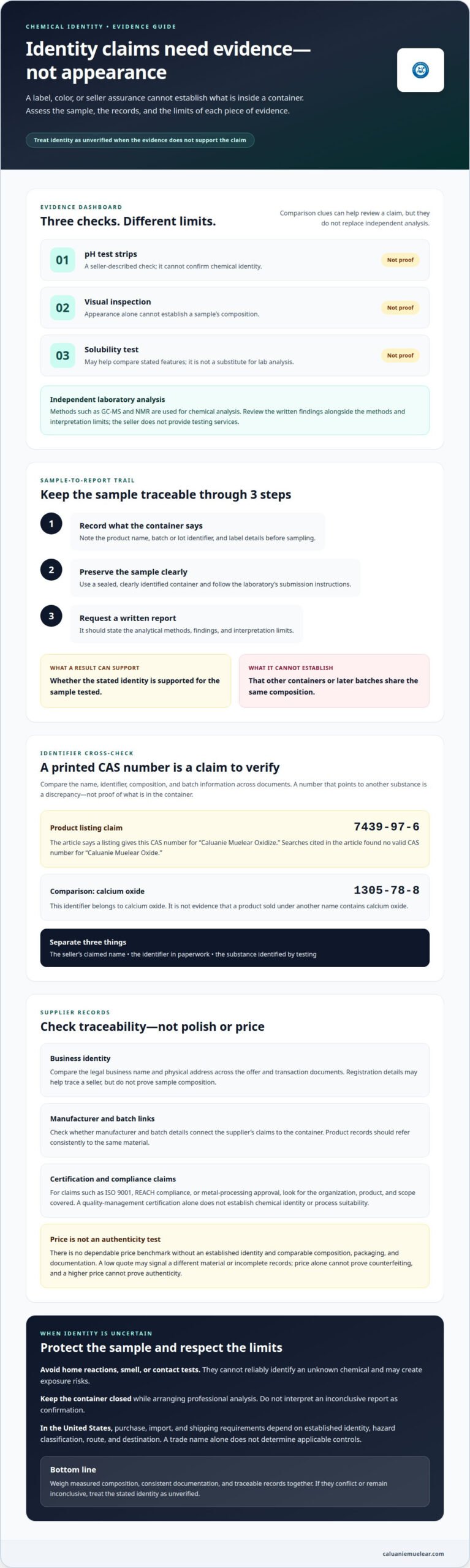
The seller describes three checks for assessing authenticity: pH test strips, visual inspection, and a solubility test. These checks can help compare a product with its stated features, but they are not a substitute for independent laboratory analysis. Popular techniques such as GC-MS and NMR are used for chemical analysis; the seller does not provide testing services.
Keep the sample traceable from container to report:
- Record the product name, batch or lot identifier, and label details before sampling.
- Preserve the sample in a sealed, clearly identified container, following the laboratory’s submission instructions.
- Request a written report that states the analytical methods, findings, and interpretation limits.
Then compare the report with the seller’s identity claim and batch documentation. For example, a report describing an unidentified mixture cannot validate a label naming a specific substance. The result applies to the sample tested; it doesn’t establish that other containers or later batches share its composition. A Caluanie Muelear real vs fake review should preserve that distinction and avoid treating one test as proof about an entire supply.
In the United States, purchase, import, and shipping requirements depend on the material’s established identity, hazard classification, route, and destination. A trade name alone doesn’t determine applicable controls, so shipping documents should describe the supported identity and hazards.
Don’t substitute home reactions, smell, or contact tests for laboratory analysis. Such checks can’t reliably identify an unknown chemical and may create exposure risks. Keep the container closed while arranging professional analysis, and don’t interpret an inconclusive report as confirmation.
Product identity and specifications
A chemical name and identifier are useful starting points, not proof of a container’s contents. A product listing gives Caluanie Muelear Oxidize the CAS number 7439-97-6. However, searches of international chemical databases, including ICCA references and the CAS Registry, found no valid CAS number for Caluanie Muelear Oxide. Treat that conflict as a reason to scrutinize the identity claim, not as a match between paperwork and material.
CAS numbers connect chemical names to registry records. For comparison, calcium oxide is identified by CAS number 1305-78-8. That identifier belongs to calcium oxide, not evidence that a product sold under another name contains it. Similar names, spelling variations, and a number printed on a label can’t substitute for consistent identity information and analytical evidence.
Review the documentation as a set. Look for the exact chemical name, identifier, composition, and batch information, then note whether each document refers to the same product. A mismatch between a label and safety document, or a CAS number that points to a different substance, is a serious discrepancy. Don’t resolve it by choosing whichever document sounds most authoritative.
In the United States, consumers can report suspected chemical fraud to a state consumer-protection office and unsafe products to a relevant local environmental or hazardous-materials authority. Keep the label, seller communications, transaction records, and any laboratory report together so the concern can be assessed against specific evidence.
For practical review, separate three things: the seller’s claimed name, the identifier shown in paperwork, and the substance identified by testing. A correct-looking identifier alone can’t establish the last point. If the records conflict, avoid relying on the product’s stated identity for a process that depends on a known chemical specification.
For industrial purchasing context, review the information accompanying metal breaking chemicals alongside the intended material specification. The key is consistency across the product name, records, and evidence, not a single printed code.
Supplier and manufacturer verification
A polished product page doesn’t establish who made or supplied a material. Review the business identity separately from the product information. A physical address, registration details, and consistent business name can help trace a seller, but they don’t prove a sample’s composition. A Caluanie Muelear real vs fake assessment should weigh these records alongside product evidence.
There’s no dependable price benchmark without a well-established product identity and comparable composition, packaging, and documentation. An unusually low quote may signal a different material, incomplete records, or a misleading offer. Price alone can’t prove a product is counterfeit, and a higher price can’t prove authenticity.
Review certification and compliance statements carefully. Sellers may claim ISO 9001 certification, REACH compliance, or approval for metal processing. Each claim should identify the organization, product, and scope it covers. A quality-management certification alone doesn’t establish a chemical’s identity or suitability for a particular process. Generic wording or a logo without supporting details isn’t conclusive evidence.
Assess the seller’s records systematically:
- Compare the legal business name and physical address across the offer and transaction documents.
- Check whether manufacturer and batch details connect the supplier’s claims to the container.
- Review whether the Safety Data Sheet names the product and an identifiable issuing organization.
- Keep written statements about origin, certification, and intended industrial use with the purchase records.
Be cautious when promotion relies mainly on viral videos, anonymous accounts, or dramatic demonstrations. Those materials don’t establish manufacturer identity or product composition. Claims of ISO 9001 or REACH compliance also need to correspond to the product and responsible organization, rather than appearing as unsupported general assurances.
For a Caluanie Muelear real vs fake decision, weigh traceability, coherent product documentation, and available identity evidence together. Conflicting records are a reason to pause before relying on a supplier’s claims. A low quote or confident sales language should never outweigh specific, consistent evidence.
What are the health hazards and safe handling requirements for products sold as Caluanie Muelear?
The exact health hazards depend on what the container holds. Products sold as Caluanie Muelear may have an unidentifiable or non-standardized composition, so a trade name alone can’t establish exposure risks. Don’t infer safety from color, odor, or a seller’s description.
Before handling, require a current Safety Data Sheet (SDS) from an identifiable, authoritative source. The SDS should describe the product’s hazards, protective measures, storage conditions, and response steps. If the document doesn’t clearly correspond to the material and its manufacturer, it can’t guide safe handling reliably. Keep the container closed until usable hazard information is available.
If handling is authorized under applicable workplace procedures, follow the SDS and use appropriate personal protective equipment (PPE). Don’t improvise with household equipment or mix the material with other substances. A trade name alone can’t establish the hazards of a mixture or reaction.
Storage controls matter. Keep containers tightly sealed and corrosion-resistant, in a cool, dry, well-ventilated area. Separate the material from flammable substances, combustible materials, reducing agents, and other incompatible substances. Inspect the container regularly for corrosion, degradation, or leakage; a damaged seal or visible leak requires prompt attention under site procedures.
- Keep the original label and SDS associated with the container.
- Restrict handling to people following the relevant workplace procedures.
- Never transfer an unknown product into an unmarked container.
- Don’t pour, dilute, or dispose of unidentified material through ordinary drains.
If you already have material sold under this name and can’t establish its identity or hazards, stop using it. Contact local environmental or hazardous-materials authorities for disposal guidance. Don’t ship or discard it casually; the substance and its condition affect safe handling and disposal. Record the label details and any visible container damage before seeking guidance, without opening or testing the material yourself.
Treat the product name as no substitute for precautions: when handling Caluanie Muelear Oxidize, use appropriate personal protective equipment. Store it in a cool, dry, well-ventilated area, away from flammable substances, reducing agents, and combustible materials; inspect storage containers regularly for degradation or leakage, and do not mix it with incompatible substances. For Caluanie Muelear Oxide, stop use and contact local environmental or hazardous-materials authorities for disposal guidance.
Caluanie Muelear Supplier
Caluanie Muelear Supplier is a source for readers assessing product claims and seeking Caluanie Muelear supply in listed container sizes. Its offerings include Caluanie Muelear 1 Liter and Caluanie Muelear Oxidize in 1.5Liters, 10Liters, and 100Liters. These options help buyers identify the product and package size relevant to their purchasing needs.
Supplier information is one part of assessing a chemical claim. It doesn’t replace independent laboratory analysis or establish a sample’s composition. Consider product identity, supporting documentation, and handling information together before relying on any material for an industrial process.
For questions about the listed Caluanie Muelear offerings, contact Caluanie Muelear Supplier.
Make Your Next Sourcing Decision Carefully
A real-versus-fake assessment of Caluanie Muelear should shape what you do next: keep identity evidence separate from purchasing decisions. If the material’s composition or hazard information remains uncertain, don’t rely on it in an industrial process. Make the next decision based on the information you can document, the intended application, and the handling requirements for the material.
When you’re ready to discuss product supply, Caluanie Muelear Supplier offers listed options including Caluanie Muelear 1 Liter, Caluanie Muelear Oxidize 1.5Liters, and Caluanie Muelear Oxidize 10Liters. Reaching out is a practical next step for readers considering those offerings. It doesn’t replace independent analysis when you need evidence about a sample’s identity.
Contact Caluanie Muelear Supplier to discuss the available product options. Take your time, keep your records together, and move forward with care.
Frequently Asked Questions
What ingredients or CAS numbers are listed for genuine Caluanie Muelear products?
A product listing gives Caluanie Muelear Oxidize the CAS number 7439-97-6, but a listing alone can’t establish ingredients or prove a sample’s identity. No verified ingredient composition is available here to state as definitive. Treat “genuine” as a claim requiring evidence tied to the specific batch, rather than assuming a name or identifier confirms what the container contains.
How can a buyer verify a chemical’s identity using a certificate of analysis and independent lab testing?
Use a certificate of analysis (CoA) as a batch-specific record, not stand-alone proof. Check that its product name and batch identifier match the container, and note the reported methods and results. Then arrange independent testing of a sample linked to that batch. Give the laboratory the claimed identity and CoA, and compare its findings with the document. Any mismatch means the identity claim needs careful review.
 English
 ភាសាខ្មែរ
 Русский
 Tiếng Việt
 한국어
 简体中文
 Қазақ тілі
 ქართული
 日本語
 Deutsch (Sie)
 O‘zbekcha
 Bahasa Melayu
 ພາສາລາວ
Recent Comments