
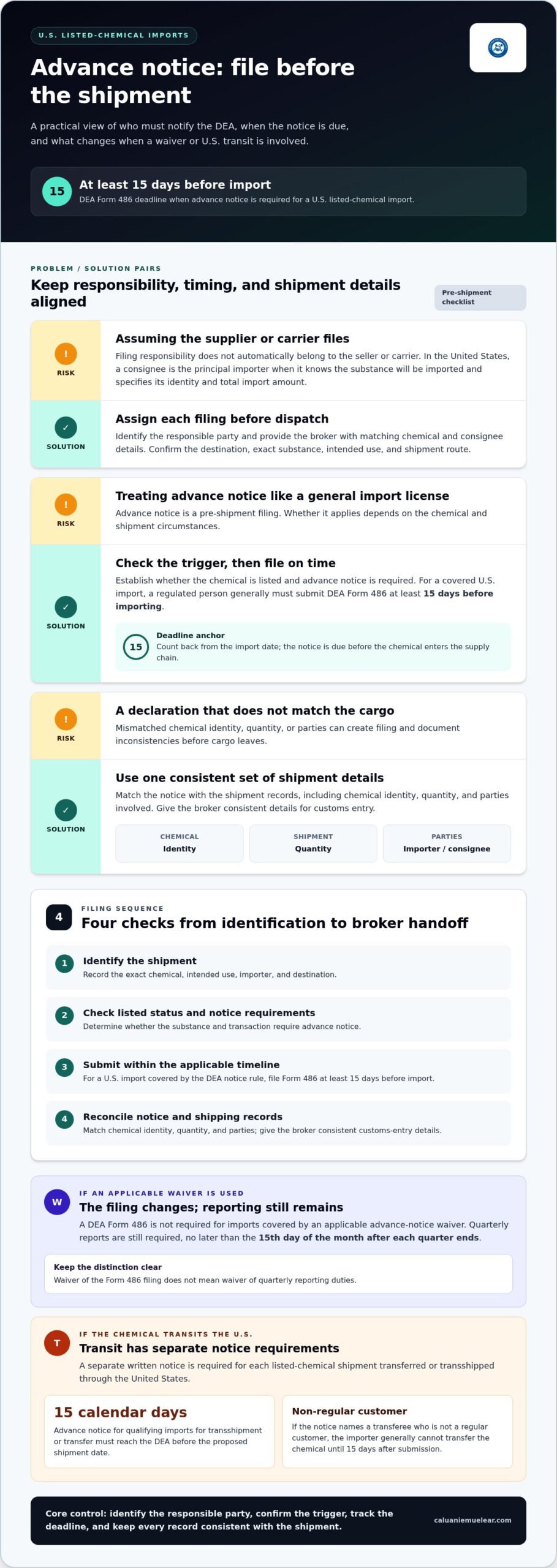
For a U.S. listed-chemical import that requires advance notice, the regulated importer must file DEA Form 486 at least 15 days before importing. That filing responsibility is a key part of understanding chemical import requirements by country, alongside any substance-specific notifications and shipment documents.
It’s easy to assume the supplier or carrier handles every regulatory filing. In practice, responsibility depends on the applicable rules and the parties involved. Knowing who must submit a declaration before dispatch can help prevent delays or refusal at the border.
This guide explains who files U.S. listed-chemical import declarations, when advance notice applies, and how that process fits broader chemical import requirements by country. It also covers potentially necessary records and transport documents, differences between U.S. and EU chemical registration rules, and what to coordinate before shipment. The practical priorities are to identify the responsible party, understand notification triggers, and keep regulatory paperwork consistent with the shipment.
Key Takeaways
- Determine which party is legally responsible for each filing before shipment; the importer’s role can depend on who specifies the substance and import amount.
- Check whether a chemical is restricted, subject to a permit, or requires advance notification in its destination country before arranging transport.
- Compare registration obligations across jurisdictions, including U.S. TSCA requirements and relevant EU REACH rules.
- Coordinate the safety data sheet, compliant labels, hazard classification, and transport paperwork so shipment documents match the chemical and its handling requirements.
- Once requirements are clear, align the shipment plan with the selected chemical and packaging size.
Importer responsibilities and shipment coordination
To assess chemical import requirements by country, first identify the destination, substance, intended use, and shipment route. In the United States, a consignee is the principal importer when it knows a substance will be imported and specifies its identity and total import amount. This matters because filing responsibility rests with the responsible party, not automatically with the seller or carrier. Assign each filing before dispatch and provide the broker with matching chemical and consignee details.
For U.S. ocean shipments, the Importer Security Filing is also known as the 10+2 rule. International ocean shipments of hazardous materials are governed by the IMDG Code for packaging, labeling, placarding, and emergency-response documentation. What rules apply to importing hazardous chemicals and dangerous goods by country? The destination’s import framework and the transport rules for each shipment leg apply. Confirm the hazard class and whether it requires a dangerous-goods declaration before committing to shipment.
What penalties and compliance risks apply to noncompliant chemical imports by country? U.S. customs may reject and investigate chemical imports without a valid, signed, and dated TSCA compliance form. TSCA section 13 requires authorities to refuse entry when a shipment would violate specified provisions. A mistaken good-faith belief that a substance is on the U.S. Inventory can still constitute a strict-liability violation under section 15(1).
Check that records match the actual cargo. Chemical identity, quantity, consignee, packaging, and transport mode should be consistent across applicable certifications and shipping documents. For U.S. imports, include TSCA certification with the chemical’s airway bill and/or shipper’s declaration. Align ocean-shipment information with the Importer Security Filing. Reviewing the destination’s chemical import requirements by country can reveal filing or document mismatches before cargo leaves.
Packaging capacity shapes shipment planning. Common formats include:
- Steel or poly drums: 55 gallons / 200 liters.
- Totes or IBCs: 275-330 gallons / 1,000 liters.
- ISO tanks for international shipments: 5,000-6,000 gallons.
- Bulk trucks: 3,000-5,000 gallons.
- Super sacks or FIBCs: 1,000-4,000 lbs.
Standard 20-foot containers carry drums, totes, or flexitanks for international chemical sourcing. Match the format to the substance, handling requirements, and destination rules. For most goods imported into the United States, a 10% universal duty went into effect on April 5, 2025, according to U.S. Customs and Border Protection. Treat duty planning as a separate coordination task from regulatory certification. A clear record set helps the importer, broker, and carrier work from consistent shipment details.
Advance import notification
Advance notice is a pre-shipment filing, not a general import license. In the United States, a regulated person generally must submit DEA Form 486 at least 15 days before importing a listed chemical when advance notice is required. The importer should identify the substance and proposed shipment details before cargo is dispatched. That timing gives authorities notice before the chemical enters the supply chain.
What are the steps and timelines for obtaining chemical import licenses or approvals? First, identify the destination country’s rules and the substance’s regulatory status. Then determine whether advance notice, a permit, or another approval applies; submit the required filing before shipment; and coordinate release documents with the broker. For a U.S. listed-chemical import requiring advance notice, the Form 486 deadline is at least 15 days before import.
Follow a clear sequence to keep the declaration consistent with the shipment:
- Identify the exact chemical, intended use, importer, and destination. These details determine which regulatory framework may apply.
- Establish whether the substance is listed and whether the transaction requires advance notice. A filing requirement can depend on the chemical and shipment circumstances.
- Submit the required declaration within the applicable timeline. For a U.S. import covered by the DEA notice rule, that means filing Form 486 at least 15 days beforehand.
- Match the notice to shipment records, including the chemical identity, quantity, and parties involved. Give the broker consistent details for customs entry.
Some U.S. importers and exporters use applicable advance-notice waivers. A waiver changes the filing process, but it does not remove reporting duties: according to the U.S. Drug Enforcement Administration, they must submit quarterly reports no later than the 15th day of the month after each quarter ends. A DEA Form 486 isn’t required for imports covered by an applicable waiver, but quarterly reporting remains required.
Transit through the United States can trigger separate notice obligations. A separate written notice is required for each listed-chemical shipment transferred or transshipped through the country. For qualifying imports for transshipment or transfer, advance notice must reach the DEA at least 15 calendar days before the proposed shipment date. If the notice names a transferee who isn’t a regular customer, the importer generally can’t transfer the chemical until 15 days after submission.
Track each deadline against the actual shipment date, not a supplier’s manufacturing or dispatch schedule. Keep the filed declaration and supporting shipping records together, so the broker can use consistent information during customs processing. For procurement involving metal breaking chemicals, keep product selection and regulatory filing as separate coordination tasks.
Which chemicals are restricted, banned, or require import permits by country?
A chemical’s import status depends on its identity, intended use, and destination. One country may require registration, advance notice, or an import permit; another may prohibit entry. Screen the chemical name, composition, and intended use separately. A broad product description alone may not identify the applicable rule.
For the United States, start with the Toxic Substances Control Act (TSCA) framework. TSCA defines importing as “manufacture,” so importing a substance absent from the U.S. TSCA Inventory is illegal unless an exemption applies. An inactive Inventory substance cannot be imported unless the importer notifies EPA of its intent before importation under TSCA section 8(b)(5)(B)(i). A new chemical may also require premanufacture notice before importation.
Some products fall outside TSCA because another U.S. law governs them. Listed exclusions include pesticides regulated under FIFRA, tobacco and tobacco products regulated under the ATF, radioactive materials regulated by the NRC, and foods, food additives, drugs, and cosmetics regulated by the FDA. TSCA exclusion does not mean a product is exempt from all other import rules. Identify the product category before treating a TSCA exclusion as complete clearance.
Other U.S. controls depend on a chemical’s function or use. A research exemption may apply only in limited circumstances, depending on how the substance is used. It must be used by or under the direct supervision of a technically qualified individual, and the quantity must be limited to what the research requires. Separately, U.S. imports of listed chemicals are permitted for medical, commercial, scientific, or other legitimate uses. The DEA may suspend an import if evidence indicates possible diversion to clandestine controlled-substance manufacture.
Use this screening sequence for each destination country:
- Record the chemical identity, mixture components, and intended use.
- Determine whether the substance is listed, inactive, new, excluded, or subject to a specific control.
- Identify the destination authority’s applicable restriction, permit, notice, or registration pathway.
- Match the filing to the importer and shipment before dispatch.
Product articles can also trigger a requirement. U.S. EPA requires import certification for articles such as furniture made with composite wood products using a formaldehyde-based resin, under 40 C.F.R. 770.30(d). For the European Union, include REACH registration status in the destination review. The key is to screen the actual substance and use, not rely on a generic label such as “industrial chemical.”
What are the chemical registration and notification requirements by country?
Chemical import requirements by country vary according to the destination’s inventory, the substance’s status, and its intended use. Registration establishes whether a chemical is covered by a regulatory framework; notification provides authorities with information about a defined substance or activity. These are separate processes, and one filing does not automatically satisfy the other. Identify the exact chemical and target market, then determine the applicable pathway before arranging shipment.
In the United States, the Toxic Substances Control Act (TSCA) treats importing as “manufacture.” Importing a substance absent from the U.S. TSCA Chemical Substances Inventory is illegal unless an exemption applies. A new chemical may require a premanufacture notice (PMN) to the Environmental Protection Agency (EPA) before importation. When a principal importer exists, that importer must submit the PMN. The U.S. Environmental Protection Agency says its review nominally lasts 90 days, but can take up to about two years in practice.
Inventory status creates another distinction. Under TSCA section 8(b)(5)(B)(i), importing an Inventory substance listed as inactive is illegal unless the importer notifies EPA of its intent before importation. A U.S. shipment also requires TSCA certification stating whether it complies with the Act. Keep that certification’s chemical identity consistent with the airway bill and/or shipper’s declaration. A correct Inventory match alone does not replace other required filings.
Intended use can trigger a separate notice. Under TSCA section 5(a)(1)(A)(ii), an importer may need to submit a significant new use notice (SNUN) before importation when the planned import or use qualifies as a significant new use. If a principal importer exists, that importer must file the SNUN. The EPA review nominally lasts 90 days, but can take up to about two years in practice. Assess both the substance and its planned activity.
Some U.S. reporting obligations are distinct from pre-import notices. The Chemical Data Reporting rule is administered under TSCA section 8(a) and 40 C.F.R. Part 711. Significant new use rules are listed in 40 C.F.R. Part 721, Subpart E. An Inventory listing therefore does not settle every reporting or use-related question.
For the European Union, include REACH registration status in the destination review. Comparing chemical import requirements by country means assessing the substance, importer’s role, intended use, and required registration or notification for each market. Before dispatch, compile the applicable inventory information, filings, certifications, and transport references in consistent shipment records.
What labeling and safety data sheet rules apply to imported chemicals in each country?
Label and safety data sheet (SDS) requirements depend on the destination, chemical classification, and transport mode. Don’t assume one label or document set covers every market. Compare the chemical’s identity and classification with destination rules, then align the package label, SDS, and transport paperwork before dispatch. A mismatch, such as a label describing a different mixture, can cause confusion during handling and customs review.
For international ocean shipments of hazardous materials, the IMDG Code governs packaging, labeling, placarding, and emergency-response documentation. These requirements apply to the ocean transport leg, so hazard details must match across container labels and transport records. Confirm the chemical’s hazard class before preparing these materials. A dangerous-goods declaration may also be required, depending on the class.
In the United States, DOT regulations apply to hazardous-material transport, including packaging, labeling, and driver certification requirements. Treat these transport rules separately from the regulations governing the chemical’s import. For example, import certification and customs records do not replace transport labels or emergency-response information. Keep each document consistent with the substance, packaging, and shipment.
Use this review for each destination and shipment:
- Match the SDS to the exact chemical or mixture, including its identity and hazard information.
- Check that package labels reflect the same substance and hazard classification shown in shipping records.
- Confirm whether the route includes ocean transport and whether the IMDG Code applies.
- Identify the destination’s applicable labeling language, format, and required supplier or importer details.
- Keep emergency-response documentation accessible to the parties handling the cargo.
Country differences matter at entry and throughout transport. A shipment entering the United States may involve DOT transport requirements, while an international ocean leg falls under the IMDG Code. If the shipment changes mode or destination, review documents for each applicable stage instead of assuming the original set remains sufficient. The responsible importer should ensure the final label and SDS match the declared chemical and planned shipment.
Before release, compare the commercial description, SDS, package marking, and dangerous-goods paperwork line by line. Resolve differences in chemical identity, hazard class, or packaging details before the cargo moves. This document-control step helps prevent handlers from relying on conflicting information and supports accurate shipment coordination.
For industrial chemical purchasing, review chemical supply options alongside the destination’s labeling and SDS requirements.
Ensure you thoroughly verify the substance identity, hazard classification, and shipment records before dispatch. For U.S. imports, U.S. CBP’s TSCA import rules cover chemical substances in bulk, chemicals in TSCA-regulated mixtures, TSCA-excluded chemicals, and certain articles containing a chemical or mixture. This scope is separate from transport labeling, so verify which TSCA category describes the goods as well as the hazards shown on the SDS.
Under the U.S. TSCA research and development exemption, a chemical must be purchased or created in a small quantity limited to what the research requires. The chemical import, export, and tariff data shown are based on reported data and are not gap-filled; users are advised to check data availability for coverage. Treat available data as a starting point, not a substitute for confirming requirements for the specific chemical and shipment.
Caluanie Muelear Supplier: Caluanie Muelear 1 Liter
Caluanie Muelear Supplier is a next step when you’ve identified the product you need and reviewed its destination-country import rules. Its listed options include Caluanie Muelear 1 Liter, Caluanie Muelear Oxidize 1.5Liters, Caluanie Muelear Oxidize 10Liters, and Caluanie Muelear Oxidize 100Liters.
Select a listed product size that fits your procurement needs, then coordinate the chemical’s identity, intended use, shipment documents, and destination rules with the responsible parties. Product sourcing and regulatory filings are separate parts of import planning, so account for both before arranging shipment.
For product information or purchasing, contact Caluanie Muelear Supplier or visit caluaniemuelear.com.
Make your next sourcing decision with the paperwork in view
Use chemical import requirements by country as a procurement filter, not a final check after purchase. Before choosing a product, match the intended order to its destination, planned use, and shipment documentation. Keep that decision trail with your purchasing records so product selection and import preparation remain connected.
Caluanie Muelear Supplier offers Caluanie Muelear 1 Liter, Caluanie Muelear Oxidize 1.5Liters, and Caluanie Muelear Oxidize 10Liters. These listed options give you product sizes to consider as you plan a procurement requirement. Select the option that fits your order, then coordinate the applicable import process with the responsible parties.
For a direct next step, contact Caluanie Muelear Supplier about the product options. Bring your intended destination and order details into the conversation, so your sourcing decision can proceed alongside your import planning. A disciplined start helps you move forward with clarity and confidence.
Frequently Asked Questions
What documents are required to import chemicals into each country?
Required documents depend on the destination, chemical status, intended use, and transport mode. Build a shipment packet around the consignment: customs-entry records, applicable import certifications or advance-notice filings, the safety data sheet, and transport declarations for hazardous cargo. For U.S. shipments, keep TSCA certification details consistent with the chemical identity and the airway bill or shipper’s declaration. Reconcile the product name, composition, quantity, and consignee across the paperwork before release.
How do chemical import requirements differ for industrial, agricultural, and consumer-use chemicals?
In the United States, requirements depend on the substance and intended use. Pesticides are regulated under FIFRA, while foods, drugs, and cosmetics fall under FDA rules; tobacco and radioactive materials also have separate regulatory frameworks. Research and development use may qualify for a TSCA exemption if its conditions are met.
What customs codes, duties, taxes, and fees apply to chemical imports by country?
Confirm the HS code with the customs broker. For U.S.
Which agencies regulate chemical imports in major markets such as the US, EU, China, and India?
In the United States, EPA oversees TSCA enforcement, CBP handles customs requirements, and DEA governs notices for listed chemicals. The EU framework identified is REACH.
 English
 ភាសាខ្មែរ
 Русский
 Tiếng Việt
 한국어
 简体中文
 Қазақ тілі
 ქართული
 日本語
 Deutsch (Sie)
 O‘zbekcha
 Bahasa Melayu
 ພາສາລາວ
ბოლო კომენტარები