
The document with more technical detail isn’t necessarily the one that answers your safety question. In the SDS vs product specification comparison, an SDS communicates hazards and safe-handling guidance, while a product specification describes stated technical properties or performance criteria. They serve different purposes, and neither should be treated as proof that a chemical has the identity, quality, or batch characteristics you expect.
It’s understandable to wonder which document to use, especially when suppliers use different names and formats. The distinction matters during chemical purchasing and workplace use: choosing the wrong document can leave a safety question unanswered or make a product claim seem more conclusive than it is.
This guide explains what each document can establish, which one to consult for common safety and purchasing questions, and how to use both together. You’ll also learn what neither can confirm on its own, including a chemical’s identity, purity, or specific batch. The practical goal is to use each document for the information it is designed to provide and recognize where its evidence ends.
Key Takeaways
- Use an SDS for hazard and safe-handling information; use a product specification to assess stated technical properties and purchasing fit.
- In an SDS vs product specification comparison, remember that a Technical Data Sheet may be one format for presenting product specifications.
- Compare documents by purpose, typical contents, intended users, and the decisions they support. Formats and contents can vary by supplier.
- Follow a clear purchasing sequence: identify the product, review technical fit, assess hazards, and file current records.
- For a named product such as Caluanie Muelear Oxidize, distinguish general product information from records tied to a specific production lot.
SDS vs. product specification: the core difference in one minute
An SDS covers chemical hazards and precautions for safe handling. A product specification describes stated properties of a defined product, such as selected physical, chemical, or performance characteristics.
Put simply: An SDS explains what hazards a chemical may present and how to respond. A product specification states properties or performance criteria associated with a product. One supports hazard-related decisions; the other supports decisions about technical fit. Neither replaces the other.
그 안에서 SDS vs product specification comparison, terminology can blur the distinction. A supplier may present product specifications in a document called a specification sheet or a Technical Data Sheet (TDS). A TDS is one possible format or label for product information, not a universal name for every specification document. Read the document’s actual contents and stated scope rather than relying on its title alone.
What does an SDS tell you?
An SDS communicates information about a chemical’s hazards, precautions, emergency response, and handling. Its standardized 16-section structure under the Globally Harmonized System (GHS) organizes information such as first-aid measures, firefighting guidance, handling and storage, exposure controls, and toxicological information. This structure helps readers locate key topics, although regulatory implementation and enforcement can differ across jurisdictions.
Workers and safety teams consult an SDS when making hazard-related decisions, such as determining which precautions apply to a task or what information is relevant during an exposure response. The Safety Data Sheet (SDS) on Wikipedia also provides a general overview of SDS purpose and structure. For actual operations, use the applicable SDS and workplace procedures. A product specification is not a substitute for safety guidance.
What does a product specification tell you?
A product specification describes stated properties or criteria for a particular product. Depending on the product and document, examples may include appearance, composition-related details, physical or chemical properties, or performance parameters. These are examples, not guaranteed fields. Manufacturers can use different headings, levels of detail, and formats, so compare the information stated with the requirements for your intended application.
A specification sheet and an SDS have different jobs, even if both mention a chemical or use some of the same terminology. A TDS may present technical product information, but its title doesn’t establish a fixed format or prove that it covers every property a purchaser needs. Check the scope, units, conditions, and any stated limits before using a value in a process or purchasing decision.
Keep the decision clear: consult the SDS for hazard and handling questions, and use the specification document to assess stated technical fit. If a document doesn’t contain the information needed for a decision, don’t infer it from another document’s purpose or title. Both documents present supplied information, and neither should be mistaken for independent confirmation of a product’s identity or a particular batch.
SDS vs. product specification: compare purpose, contents, and users
The practical distinction is the decision each document supports. An SDS organizes hazard and response information; a product specification presents stated product characteristics that may help determine technical suitability. Contents and formats can vary, so treat the examples below as typical rather than guaranteed fields.
| Comparison | SDS | Product specification |
|---|---|---|
| Purpose | Communicate hazards, precautions, and response guidance. | Describe stated product properties or performance criteria. |
| Typical contents | Hazard identification, first aid, firefighting, accidental release, handling and storage, exposure controls. | May include physical or chemical values, product characteristics, test methods, or acceptance criteria. |
| Primary users | Workers, supervisors, and environmental health and safety teams. | Purchasing, engineering, and process teams. |
| Decision supported | How to manage hazards and respond to an incident. | Whether stated technical information fits a purchasing or process requirement. |
A specification’s meaning depends on its scope and context. In a regulated area such as pharmaceuticals, the FDA guidance on chemical product specifications discusses specifications through test procedures and acceptance criteria for drug substances and products. That guidance is specific to its subject and doesn’t establish a universal format for industrial chemical specification sheets. Legal requirements for SDSs also depend on the applicable jurisdiction and setting.
Which document answers which question?
For exposure controls, consult the SDS’s relevant hazard and exposure information, commonly found in Sections 2 and 8. First-aid, firefighting, and spill-response questions point to Sections 4, 5, and 6; storage and handling guidance is commonly in Section 7. For a stated property or technical selection criterion, consult the product specification. Compare its stated value, units, conditions, and limits with the requirement. For example, a purchaser evaluating an industrial chemical such as Caluanie Muelear Oxidize would use the SDS for hazard questions and the specification for stated technical criteria, without treating either as proof about a particular batch.
Who uses each document at work?
Workers may consult SDS information before handling a chemical or responding to an incident. Supervisors and environmental health and safety teams use it to support workplace hazard communication and related procedures. Purchasing staff may compare specifications against procurement requirements, while engineering or process teams assess whether stated criteria suit an intended application. One person may need both documents, but for separate decisions.
They complement each other; neither replaces the other. For procurement involving Caluanie Muelear Oxidize, keep the safety review distinct from technical selection, and use each document only for the information it actually provides. Explore Caluanie Muelear Oxidize as a product category in an industrial sourcing context.
What an SDS or product specification cannot prove by itself
An SDS or product specification tells you what information the document contains. Its title, layout, or technical detail doesn’t automatically make it independent laboratory verification. A specification may state a target property or value, and an SDS may identify a chemical by name, but those statements alone don’t establish that a delivered material has the claimed identity, purity, or batch quality.
Keep general product information separate from evidence tied to a specific production lot. A document may describe a product or its intended criteria without identifying the lot in a shipment. Even when a value appears precise, don’t assume it applies to every batch unless the document’s scope and identifiers support that conclusion. Visual inspection, informal chemical tests, and handling experiments are not substitutes for appropriate verification.
For chemical purchasing, ask not only, “What does this document say?” but also, “What material, lot, and evidence does this information refer to?” The SDS vs product specification distinction clarifies document purpose, but it cannot close an evidence gap on its own.
How does a Certificate of Analysis differ?
A Certificate of Analysis (CoA) is a separate document that may report analytical results for a particular batch. Depending on its contents, it may identify the lot, tests performed, and reported results. A CoA is not an SDS, which communicates hazard information, or a general specification, which describes stated product properties or criteria.
Don’t assume every product, supplier, or transaction includes a CoA, or that the document’s title alone establishes its evidentiary value. Consider whether the reported results are tied to the relevant lot and provide enough context for the decision you need to make. A CoA is still a supplied record; its existence alone does not establish independent verification.
What if document details do not align?
Pause and resolve discrepancies before relying on the affected information. Compare the product name, identifiers, revision dates, and stated properties across the documents and purchasing records. A difference may have an explanation, such as a revised document or a mismatch in scope, but don’t fill the gap with an assumption.
- Check whether each document refers to the same product and, where applicable, the same lot.
- Review revision dates and identifiers for inconsistencies or outdated records.
- Compare conflicting property statements against the decision they are meant to support.
If a discrepancy could affect hazard controls, technical suitability, or shipment acceptance, pause that decision until the records are reconciled. Record what didn’t match and what information resolved it. This is a basic part of industrial chemical supplier due diligence: assess the documentation as a set, understand its limits, and don’t treat paperwork as proof beyond its scope.
How to use both documents in a chemical purchasing workflow
A disciplined review keeps two decisions separate: whether a product appears to meet technical requirements, and how its hazards should be managed at work. The documents support different parts of that process. Match each document review to the decision you’re making, and don’t use one as a substitute for the other.
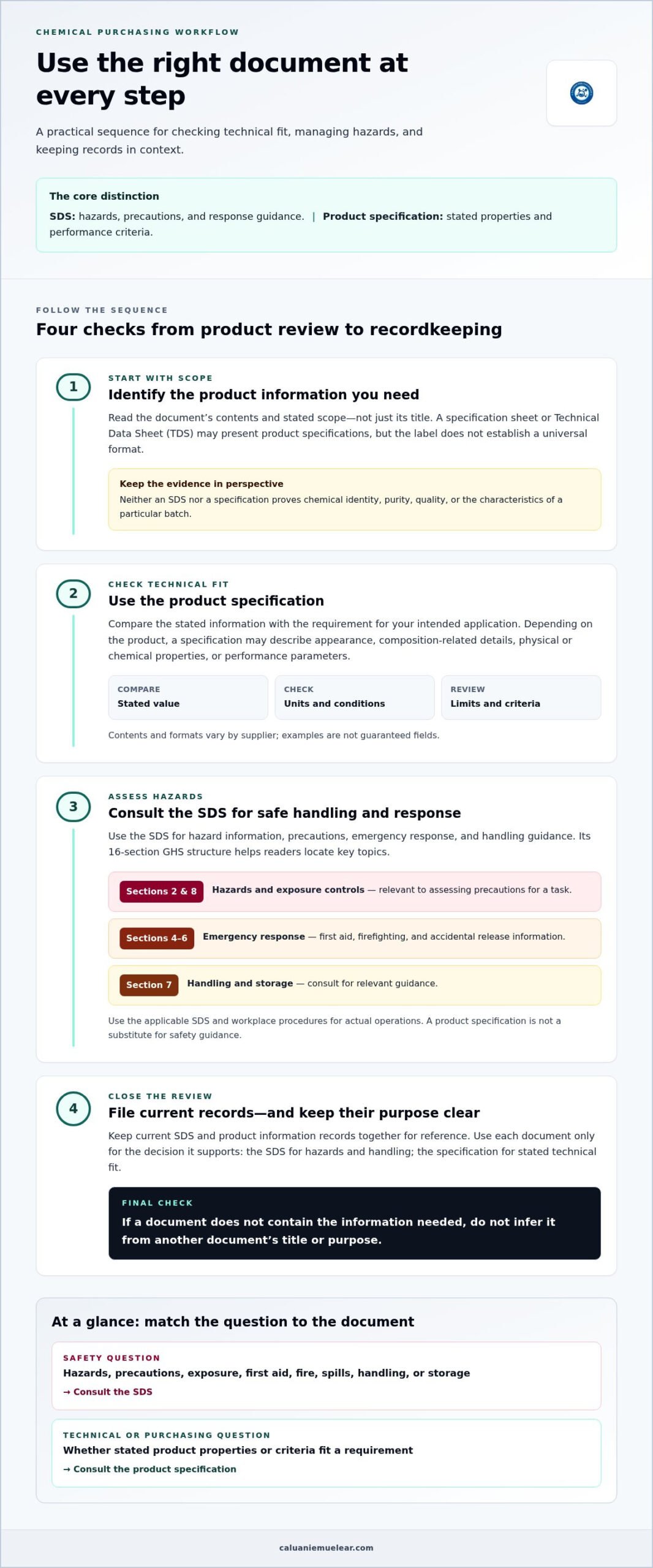
- Identify the product. Compare the product name and identifier across the purchasing record, SDS, and specification. Note document revision dates and, where relevant, the production lot reference. If details conflict, pause the decision affected by the discrepancy until it is resolved.
- Review technical fit. Compare the specification’s stated properties, units, test conditions, and limits with documented process or purchasing requirements. Record which criteria match and which remain unanswered. A product name or broad marketing description isn’t evidence that technical requirements are met.
- Assess hazards. Use the SDS to review relevant hazard information, precautions, first aid, handling, storage, and response guidance. Keep this workplace hazard review distinct from purchasing or process-performance decisions.
- File current records. Retain the documents used for the decision, including their revision dates and any relevant product or lot identifiers. Make applicable SDS information accessible to workplace personnel who need it, and replace outdated records when current versions are obtained.
Review technical fit before operational use
Translate process needs into specific criteria before comparing them with a product specification. Identify which stated property matters, which units and conditions apply, and what range or limit the process requires. Record the product identifier, specification revision, and relevant lot reference so the basis for selection remains clear. If the document doesn’t address a required criterion, don’t infer suitability from a similar product name or description. Whether evaluating heavy industrial agents or specialized mineral treatments from suppliers like Magnexa, aligning specifications with precise operational requirements prevents costly mismatches.
Use the SDS for hazard communication
Read the SDS sections relevant to the planned work, rather than relying on a quick glance at a hazard label or one isolated section. Use its information alongside workplace procedures to support hazard communication and preparation for exposure or other incidents. Keep the applicable SDS accessible to relevant personnel, including workers and supervisors who may need its guidance.
Requirements for SDS preparation, access, labeling, and workplace communication can depend on the destination and workplace jurisdiction. This general comparison between an SDS and a product specification isn’t legal advice for every location. Identify current rules that apply to the chemical and setting, and keep those obligations separate from the technical purchasing review.
For industrial sourcing, apply the same sequence to products such as Caluanie Muelear Oxidize: match documents to the product and the decision, then keep technical selection distinct from hazard review. Explore Caluanie Muelear Oxidize options as part of your purchasing research.
Apply the distinction to industrial chemical sourcing
In industrial procurement, document review is one part of a larger decision. Consider Caluanie Muelear Oxidize as a named product category: its name can help identify what is being discussed, but it doesn’t establish that a particular shipment matches expectations. An SDS communicates hazard information, while a product specification states technical properties. Neither, on its own, proves authenticity, purity, or batch quality.
Keep product, document, and batch references aligned
Start by matching the product name and identifier on each document to the item under review. Then note the revision date and, when provided, any lot or batch reference. These details help establish which product information you’re using and whether a record relates to a specific shipment. If a document has no lot reference, don’t assume its general statements are lot-specific evidence.
Package size helps distinguish order quantities, not verify technical properties. A product name or broad marketing description has the same limit: it identifies a category or claim, but doesn’t independently confirm the material’s composition or condition. Keep those distinctions clear in purchase records, especially when comparing documents with different titles or formats.
Make a decision using the right evidence
Use the SDS for hazard communication and workplace precautions. Use the specification for stated technical properties and selection criteria. If acceptance depends on a claim about a particular lot, general product information may not be enough. The decision calls for appropriate batch-specific evidence that can be connected to that lot. Consider what the evidence covers, which material it refers to, and whether it addresses the claim at issue.
This is the practical value of understanding SDS vs product specification: it keeps safety review, technical selection, and batch-level evaluation from being treated as one question. A document can be relevant without answering every procurement concern. If names, identifiers, revisions, or lot references don’t align, pause decisions that depend on those details until the discrepancy is resolved.
For broader sourcing context, a buyer’s guide to metal breaking chemicals can help organize product and supplier considerations alongside document review. Use it to complement the records for the specific product, not to replace examination of what those records state. When a purchasing decision depends on batch details, keep the batch reference attached to the evidence used in that decision.
Caluanie Muelear Oxidize is one example of an industrial chemical category where clear document handling matters. Keep safety, technical, and batch questions separate, and don’t assign a document more evidentiary weight than its contents support. Explore product information as part of your sourcing research, while assessing descriptions and records according to their stated scope.
Make document review part of your next sourcing decision
Build a simple document-control habit before your next order: record which decision each document supports, note its revision, and keep unresolved questions visible instead of filling gaps with assumptions. That makes the SDS vs product specification distinction practical, especially when a purchasing decision also depends on evidence tied to a specific lot.
As you plan your next procurement, use product information to understand the stated scope of what’s being sourced, then assess safety and technical requirements through the appropriate records. Caluanie Muelear Supplier distributes Caluanie Muelear Oxidize, heavy water, and other industrial chemicals, with Caluanie Muelear Oxidize offered in multiple package sizes.
Explore Caluanie Muelear Supplier’s industrial chemical products as you prepare your sourcing review. Browse Caluanie Muelear Oxidize, heavy water, oxidizing agents, and metal breaking chemicals for your procurement needs.
Frequently Asked Questions
Is an SDS the same as a product specification?
No. An SDS supports safety decisions, while a product specification helps assess stated technical requirements. A safety review before handling a chemical calls for relevant SDS information; checking whether a stated property meets a purchasing criterion calls for the specification. A Technical Data Sheet may present specification details, but titles vary. In the SDS vs product specification comparison, judge each document by its scope, not its name alone.
Can a product specification replace an SDS?
No. A specification generally won’t cover all the hazard communication needed for workplace use, such as precautions or emergency-response details. If a purchasing file contains a specification but no applicable SDS, don’t treat the specification as a safety substitute. Identify the requirements that apply to the product and workplace, then use current safety documentation alongside established workplace procedures.
Does an SDS prove a chemical’s identity or purity?
No. An SDS is not independent analytical proof of identity, purity, or conformity for a delivered lot. Product-identifying details help connect the document to a chemical, but they don’t show that a particular shipment was analyzed. If a decision depends on a lot-specific result, review evidence that identifies that lot, such as an applicable Certificate of Analysis, and assess whether it addresses the relevant claim.
What is the difference between an SDS and a TDS?
An SDS focuses on hazards and safety-related information; a TDS, or Technical Data Sheet, typically presents technical product information. A TDS may function as a product specification document, but its title doesn’t guarantee a particular set of fields or level of detail. If a process requires a value measured under a particular condition, check that the TDS states the value and its conditions rather than assuming the heading covers it.
Do all chemical products have a product specification sheet?
Not necessarily as a separate document with a standard title or layout. Technical information may appear in a TDS, specification sheet, or another product document, and its scope can differ. For a purchasing review, write down the exact properties needed and compare them with what the document actually states. Missing information should remain an open question, not an assumed value or a safety conclusion.
What should I do if the SDS and product specification show different information?
Pause any decision that relies on the conflicting detail until the discrepancy is resolved. First compare product identifiers, document revisions, and any lot references, since the records may cover different versions or scopes. Note the specific mismatch, such as a different product identifier or property statement. Don’t reconcile it through guesswork or informal testing; use appropriate documentation and workplace procedures.
Is an SDS format the same in every country?
No. The GHS provides an international framework, but countries and regions implement chemical communication through their own regulatory systems. For instance, Canada’s WHMIS and the United States’ OSHA Hazard Communication Standard are distinct systems. If a chemical is supplied across borders or used in a workplace in another jurisdiction, identify the destination and workplace rules that apply, then verify current requirements rather than assuming one format satisfies every setting.
 English
 ភាសាខ្មែរ
 Русский
 Tiếng Việt
 한국어
 简体中文
 Қазақ тілі
 ქართული
 日本語
 Deutsch (Sie)
 O‘zbekcha
 Bahasa Melayu
 ພາສາລາວ
최신 댓글