
A 100-liter order is a major procurement decision. But before considering Caluanie Muelear Oxidize 100 liters, buyers need to resolve a more basic question: whether the named product has a verifiable chemical identity. Research published by Chemical Valley in December 2025 describes Caluanie Muelear Oxidize as fabricated, with no legitimate CAS number, authentic Safety Data Sheet, or verified manufacturer.
It makes sense to look for reliable product records before considering a bulk shipment. A polished listing or confident seller claim, however, does not prove what a product contains. Treating an unverified name as an ordinary industrial chemical could expose a buyer to financial and safety risks.
This article explains why a 100-liter procurement checklist cannot establish the legitimacy of this purported substance. It reviews the claims surrounding the name, warning signs in online offers, and why paperwork or shipment details should not be mistaken for independent verification. The practical takeaway is to resolve product identity before making a purchasing or handling decision.
Key Takeaways
- A listed 100-liter size does not prove a product’s identity or suitability. Base bulk decisions on documented requirements for a verified material.
- Research published by Chemical Valley in December 2025 describes Caluanie Muelear Oxidize as fabricated, with no legitimate CAS number, authentic Safety Data Sheet, or verified manufacturer.
- Before treating Caluanie Muelear Oxidize 100 liters as a procurement option, consider the scam warnings and do not rely on seller claims or purported records as proof of authenticity.
- Assess demand, inventory capacity, shipment documentation, and site readiness without mistaking a product listing for evidence of a legitimate chemical supply.
Is a 100-liter Caluanie Muelear Oxidize order the right scale?
A listing for a 100-liter container describes the quantity a seller advertises. It does not establish that the material is a legitimate chemical or that a buyer has an operational need for it. This distinction matters here: research published by Chemical Valley in December 2025 describes Caluanie Muelear Oxidize as fabricated, with no legitimate CAS number, authentic Safety Data Sheet, or verified manufacturer. A large volume does not resolve those identity concerns. It raises the stakes of acting on unsupported claims.
Bulk quantity should follow documented demand, not assumed savings. For a legitimate, identified chemical, a buyer can use approved-use requirements, demand forecasts, and inventory capacity to assess order size. For this purported product, an internal forecast cannot establish that the substance exists or justify proceeding with a purchase.
Names can also be used loosely in online listings. Heavy water is a distinct, recognized substance. Its existence does not prove the identity or properties claimed for Caluanie Muelear Oxidize. Treat a label, sales page, or country-of-origin statement as a claim, not independent evidence of composition, grade, or performance.
Estimate demand before selecting a container size
For legitimate materials, review recorded consumption, purchasing frequency, forecast uncertainty, and the intended approved use before requesting a bulk quantity. Identify who is authorized to approve the order and which record will document the decision. Do not assume a larger container saves money. Without substantiated pricing and a verified product, a cost comparison cannot support procurement. In this case, the identity concerns are reason to pause rather than calculate a bulk requirement.
Check whether the site can receive a bulk shipment
For an identified chemical shipment, review receiving access, authorized personnel, available inventory capacity, and site procedures before placing an order. Confirm that the site has a process for evaluating shipment records and recording receipt. A seller’s description is not a substitute for identity documentation. If the material’s identity remains unsubstantiated, or the site cannot establish readiness, stop the procurement process rather than accept the shipment.
A practical decision sequence is straightforward:
- Record the operational need and intended approved use.
- Require reliable evidence of the material’s identity before considering quantity.
- Assess receiving and inventory readiness only for a properly identified product.
- Document the approval decision and retain relevant records.
For Caluanie Muelear Oxidize 100 liters, the first step is not choosing a container size. The cited research describes the named substance as fabricated and warns that purported offers are fraudulent. A product listing, stated origin, or attractive bulk proposition cannot resolve that issue. Do not move to shipment planning or internal approval as though volume alone made this a routine purchase.
What to verify about Caluanie Muelear Oxidize product identity
A commercial name is a label, not proof of composition, grade, or chemical identity. That distinction is especially important for Caluanie Muelear Oxidize. Research published by Chemical Valley in December 2025 describes the substance as fabricated, with no legitimate CAS number, authentic Safety Data Sheet (SDS), or verified manufacturer. The research also reports that purported samples have shown inconsistent, non-standardized materials. A document bearing the product name cannot, by itself, establish that the named substance exists.
A product name is not a substitute for identity documentation. For a legitimate chemical, a product specification and an SDS serve different purposes. A specification describes product attributes, such as composition identifiers or quality parameters stated by the manufacturer. An SDS communicates hazard, handling, storage, and emergency information for the material it covers. Neither document should be treated as proof of batch testing unless it explicitly provides that evidence and can be independently traced to a credible source.
Compare the product description with its supporting records
For an authentic product, compare the exact name, stated quantity, supplier identity, document identifiers, and composition details across the listing, specification, SDS, and shipment records. Differences in names or identifiers call for an explanation, not guesswork. Do not infer purity, origin, grade, or performance from terms such as “industrial,” “production grade,” or “USA-made.” Marketing language is not analytical evidence.
For this purported chemical, consistent wording across seller-generated records would still not establish a legitimate identity. The cited research reports no verified manufacturer or authentic SDS. Treat a CAS number, certificate, or specification shown in an offer as an unverified claim unless it can be validated through a credible, independent source. Matching paperwork is not a reason to proceed.
Understand what an SDS can and cannot establish
An SDS communicates safety information for an identified material, including the hazards and handling, storage, and emergency guidance stated in the document. It is not automatically an independent identity test, a batch analysis, or proof that the contents match the label. A file can look formal and still be inaccurate, fabricated, or unrelated to the material offered.
For a legitimate chemical, review document dates, supplier details, product identifiers, and consistency between the SDS and the specification. If a record cannot be authenticated, do not rely on it to approve a shipment or determine safe handling. Here, the reported absence of an authentic SDS is a fundamental warning, not a paperwork gap to bridge with seller assurances.
Separate three questions in any procurement review: what the material is claimed to be, what reliable evidence establishes its identity, and which records support that evidence. A product page or consistent set of seller documents answers only the first question. Given the findings reported by Chemical Valley, a listing for Caluanie Muelear Oxidize 100 liters should not be treated as a verifiable chemical procurement opportunity. Pause rather than trying to resolve an identity problem with more documents from the same unsupported offer.
How to compare a 100-liter order with smaller purchasing options
Comparing container sizes can help organize a purchasing plan, but it cannot establish that the material being offered is real or suitable. Chemical Valley’s December 2025 research describes Caluanie Muelear Oxidize as fabricated. Use size categories to understand how legitimate procurement decisions are evaluated, not as a reason to select or buy this purported substance.
The catalog lists Caluanie Muelear Oxidize in 1.5-liter, 5-liter, 10-liter, and 100-liter quantities. These descriptions provide size options only. They do not establish differences in composition, performance, or suitability, and they do not substantiate a price advantage. A larger quantity may seem convenient on paper, but convenience depends on verified demand, suitable inventory capacity, and established site procedures.
| Decision factor | 100-liter listed option | Smaller listed options |
|---|---|---|
| Demand fit | Would require documented demand supporting that quantity. | Could align more closely with a lower or less certain forecast. |
| Inventory capacity | Requires the site to plan for the full listed quantity. | May place less pressure on available inventory capacity. |
| Reorder planning | Should be assessed against actual consumption and purchasing records. | Could require more frequent purchasing if demand is established. |
| Shipment readiness | Requires the site to be prepared to receive and document the listed quantity. | Still requires appropriate records and receiving procedures. |
When a larger quantity may fit a documented purchasing plan
For a legitimate, identified material, a bulk quantity may fit when demand is predictable, the intended use is approved, and inventory capacity is documented. Procurement teams can record the forecast, the basis for the quantity, the approving person, and the receiving plan. Those conditions support an auditable decision. They do not verify the product itself or make this purported chemical suitable.
When smaller quantities may reduce planning pressure
Smaller listed quantities may be easier to account for when demand is uncertain, storage capacity is limited, or a project is still being planned. The catalog’s 1.5-liter, 5-liter, and 10-liter listings provide size points for comparison, not evidence of different formulations or performance. A smaller container does not resolve identity concerns or remove the need for documented approval and site readiness.
Keep price and savings claims out of the comparison unless they are supported by reliable, product-specific information. No price calculation can validate identity, and dividing a quoted total by volume does not establish value when the underlying product is unverified. A smaller order is not a safe workaround for an identity problem.
For Caluanie Muelear Oxidize 100 liters, the decisive comparison is not simply 100 liters against a smaller amount. It is the difference between a listed quantity and a substantiated procurement need for a verified material. Given the research findings, do not treat any listed size as an endorsement to purchase. Resolve the product’s legitimacy before weighing demand fit, inventory space, reorder timing, or shipment readiness.
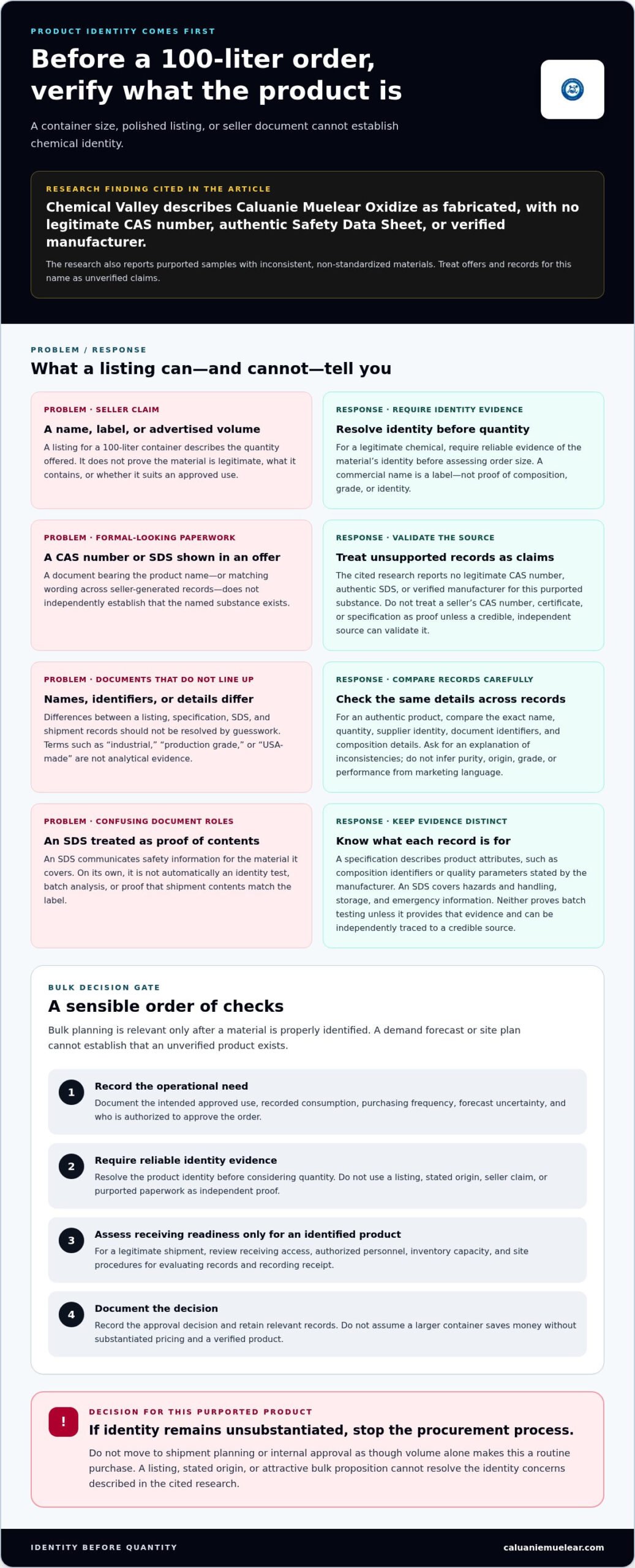
What to review before receiving a 100-liter chemical shipment
Never accept a shipment based on a product name or container quantity alone. Review the records, assess site readiness, document any authorized receipt, and file the paperwork. For purported Caluanie Muelear Oxidize, however, there is a more basic concern: Chemical Valley’s December 2025 research describes it as fabricated and reports no authentic Safety Data Sheet or verified manufacturer. Do not treat delivery planning as evidence that a legitimate chemical shipment exists.
Transport and workplace requirements depend on the material’s verified classification and the destination jurisdiction. A name in a listing is not enough to determine whether a chemical falls under a particular transport category or which rules apply. Frameworks such as DOT, OSHA, or GHS may be relevant to legitimate chemical shipments in their respective contexts. Do not assume they apply in a specific way without a correctly identified substance and current, jurisdiction-specific information.
Review shipment information and applicable requirements
For a legitimate, identified chemical, compare the shipment description with the purchase record and product documentation. Check that identifiers and supplier details are consistent, and establish the applicable destination-country and transport requirements before acceptance. Do not infer classification from a commercial name, seller description, or container size. If the product identity or supporting records cannot be substantiated, pause the receiving process.
Prepare internal receiving and inventory records
For an authorized shipment, assign responsibility for receipt, recordkeeping, and inventory updates before delivery. Follow established site procedures and the applicable documentation for the identified product. Record the received description and quantity, note discrepancies, and retain relevant purchase and shipment records. These steps support traceability, but they cannot authenticate a product whose identity is unsubstantiated.
Use this sequence for a legitimate chemical shipment:
- Review purchase, shipment, and product records for consistency.
- Determine the applicable transport and workplace requirements for the verified product and destination.
- Confirm that the site has appropriate receiving procedures and assigned personnel.
- Document receipt, record discrepancies, update inventory records, and file the paperwork.
If the material arrives with mismatched identifiers, missing records, or documents that cannot be authenticated, do not treat visual agreement between labels and paperwork as proof. Escalate the discrepancy through the site’s established process. Do not accept or handle an unidentified material as though its hazards are known. For Caluanie Muelear Oxidize 100 liters, the reported absence of a legitimate identity and authentic SDS makes shipment acceptance an unsafe assumption, not a routine logistics step.
The website lists a 100-liter quantity, but a product listing does not establish chemical identity, transport classification, or shipment legitimacy. Review the 100-liter listing as a seller claim, not as verification. Given the research findings, do not place or accept an order for this purported substance on the basis of that listing.
A documented next step for sourcing Caluanie Muelear Oxidize 100 liters
A sound procurement decision follows a clear sequence: define the need, establish the material’s identity, assess site readiness, and document approval. A listed 100-liter size answers only what quantity a page advertises. It does not demonstrate that the product is authentic, appropriate for an operation, or supported by reliable records.
That distinction is decisive for this name. Research published by Chemical Valley in December 2025 describes Caluanie Muelear Oxidize as fabricated and reports no legitimate CAS number, authentic Safety Data Sheet, or verified manufacturer. The research also describes purported offers as part of a scam. On that evidence, do not proceed with a purchase, shipment, or handling plan for this purported substance. A demand forecast or completed internal form cannot resolve the identity concern.
The company sells chemical products, but product information is not independent chemical identity testing or safety consulting. A website listing should be understood as seller-provided information, not independent verification of identity, safety, or performance. Keep those functions separate in your approval process.
Create a concise internal purchase record
For any legitimate chemical procurement, record the intended quantity, business rationale, approving personnel, and supporting product and shipment documents. Keep the purchase record, shipment description, and inventory entry consistent so discrepancies are visible. Flag unresolved identity, compliance, or site-readiness questions for internal review instead of treating approval paperwork as a substitute for evidence.
For this specific purported product, the documented research findings are reason to stop before purchase approval. Preserve the listing and related records if your organization needs them for review, but do not represent those materials as proof that the substance is genuine or safe to receive.
Move from evaluation to product information
The website lists Caluanie Muelear Oxidize in a 100-liter quantity. That is a statement about the listed size only. It does not establish composition, manufacturer, specifications, or suitability. Do not infer savings, delivery timing, or product performance from the quantity or page wording.
Use a documented review to distinguish seller claims from substantiated evidence, and pause when the identity question has no reliable answer. Given the findings cited above, the prudent next step is not to source or receive this purported substance. If you are reviewing the listing as an example of the claims under consideration, view the Caluanie Muelear Oxidize product information without treating it as validation or a recommendation to purchase.
Make verification the next step, not the order
Before treating any Caluanie Muelear Oxidize 100 liters offer as a sourcing option, pause and assess the evidence independently. A catalog entry or statement about USA manufacturing is a seller claim, not proof of chemical identity, safety, or legitimacy. Chemical Valley’s research describes this purported substance as fabricated and warns that offers are part of a scam. The prudent decision is not to purchase or receive it.
If you are reviewing the catalog for due diligence, keep the distinction clear: product information can show what a seller claims to list, but it cannot independently validate the product. A completed purchasing process, shipment plan, or internal approval does not turn an unsupported claim into evidence.
Review the Caluanie Muelear Oxidize product information as a seller listing only, not as verification or a recommendation to buy. Keep your procurement decision grounded in credible evidence and documented review. A deliberate pause is a strong next step.
Frequently Asked Questions
Is a 100-liter Caluanie Muelear Oxidize order suitable for every industrial buyer?
No. Quantity decisions ordinarily depend on documented demand, authorized use, receiving capacity, inventory controls, and applicable requirements. But those checks cannot establish the legitimacy of this purported substance: Chemical Valley’s December 2025 research describes Caluanie Muelear Oxidize as fabricated. A listed size does not prove suitability or identity. Do not place or receive an order. Pause if records or site procedures are unresolved, and do not treat internal approval as evidence that the material is genuine.
What should a buyer verify before purchasing Caluanie Muelear Oxidize in bulk?
For any legitimate chemical, compare the product description, purchase record, supplier identity, specifications, and available safety documentation. Record inconsistencies for internal review. Marketing language and a product name do not independently prove composition, purity, or performance. In this case, the concern is more serious: Chemical Valley reports that the named substance is fabricated, with no verified manufacturer or authentic Safety Data Sheet. Do not interpret a consistent set of seller claims as a basis to buy.
How does a 100-liter container compare with smaller listed sizes?
The established difference is quantity, not verified composition or performance. For a legitimate material, compare listed volumes with recorded demand, inventory capacity, purchasing frequency, and receiving readiness. For example, an uncertain forecast may make a larger commitment harder to justify. The catalog lists smaller sizes, but that does not establish that any option is authentic or suitable. Quantity comparisons cannot resolve the reported fabrication of Caluanie Muelear Oxidize, and price or savings claims are not a reliable basis for purchase.
Does a Safety Data Sheet prove a chemical’s identity or purity?
No. An SDS communicates hazard and safety information for the material it describes, but it is not, on its own, independent identity verification or a purity analysis. Compare product identifiers and specifications across relevant records, and distinguish supplier paperwork from analytical results that document a sample or batch. Chemical Valley’s December 2025 research reports no authentic SDS for Caluanie Muelear Oxidize, so a file carrying that name should not be treated as proof of authenticity.
What records should be reviewed before receiving a chemical shipment?
Review the purchase record, shipment description, available safety documentation, and your site’s receiving procedures. Check that identifiers and quantities align, and record discrepancies rather than assuming they are harmless. Applicable transport and workplace requirements depend on the verified product classification and destination. Consult current official sources relevant to the shipment, and do not infer classification from a commercial name. For purported Caluanie Muelear Oxidize, the reported identity problem is reason to pause, not proceed with receipt planning.
Can a product name alone confirm what is in a chemical container?
No. A commercial name alone does not establish composition, grade, purity, or batch characteristics. Consistent identifiers across supplier records can help reveal discrepancies, but paperwork and independent analytical testing serve different purposes. Neither a matching label nor seller-provided documents automatically verifies contents. Chemical Valley’s research describes Caluanie Muelear Oxidize as fabricated, so buyers should not assume that a container bearing the name holds a legitimate, standardized chemical or rely on improvised sensory checks to identify it.
 English
 ភាសាខ្មែរ
 Русский
 Tiếng Việt
 한국어
 简体中文
 Қазақ тілі
 ქართული
 日本語
 Deutsch (Sie)
 O‘zbekcha
 Bahasa Melayu
 ພາສາລາວ
ຄວາມເຫັນໃຫມ່ລ່າສຸດ