
A complete-looking supplier file can still leave you unable to verify what you’re buying, whether the documents match the product, or which requirements apply to the shipment. That’s the risk industrial chemical supplier due diligence is designed to address. Purchasing teams know paperwork matters. The challenge is deciding whether each record is relevant, consistent, and strong enough to support a purchase. A document count isn’t proof; the evidence needs to line up.
This checklist gives you a repeatable, risk-based review before you commit. Assess the supplier’s identity, compare product-specific documents with the intended purchase, and identify compliance questions tied to the product, shipment, and destination. Then review purchasing and shipment records so your decision remains traceable. At each stage, decide whether the evidence supports proceeding, whether a gap calls for a pause, or whether a concern should be escalated. The aim is a purchasing decision based on records, not general assurances.
Key Takeaways
- Use industrial chemical supplier due diligence to assess supplier, product, transaction, and jurisdiction risks as separate evidence checks.
- Compare the contracting entity, invoice, product description, and shipping records to spot inconsistencies before purchase.
- Understand what each document can establish: an SDS, product specification, certificate, and shipment record serve different purposes.
- Determine which compliance frameworks may apply by considering the chemical, transaction, route, and destination, rather than assuming one rule set fits all.
- Build a traceable proceed, pause, or escalate decision record that captures the evidence reviewed and any unresolved issues.
What industrial chemical supplier due diligence should establish
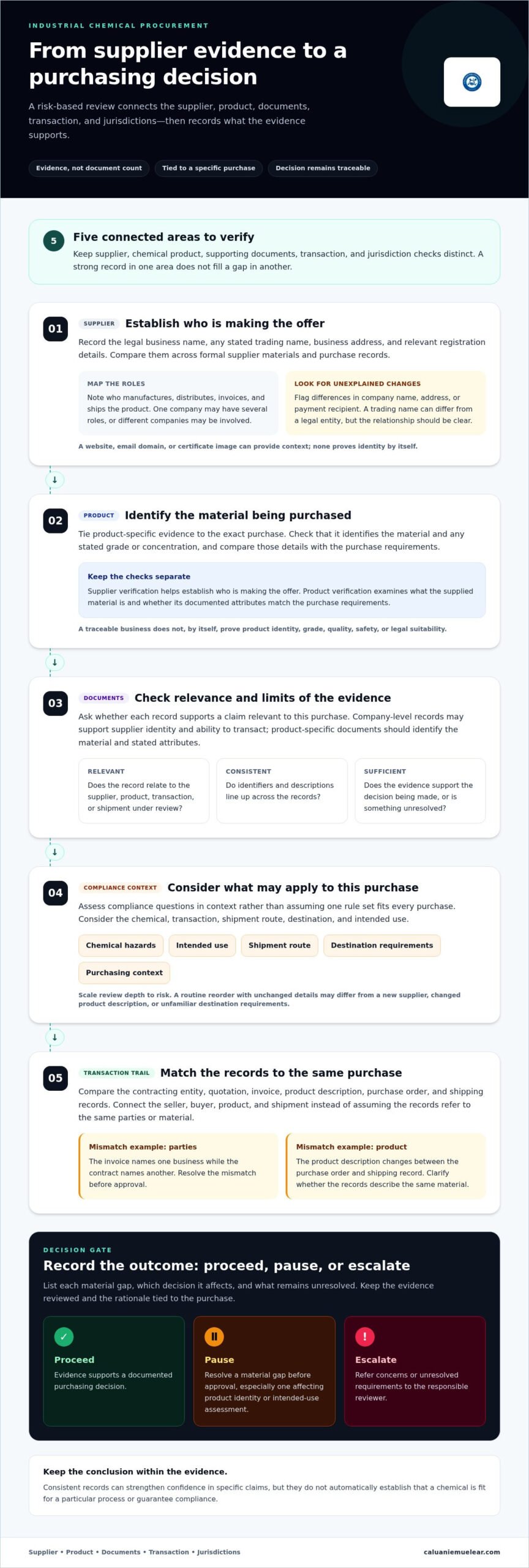
Industrial chemical supplier due diligence is a documented review of the claims and risks relevant to a specific purchase. It considers five connected areas: the supplier, the chemical product, its supporting documents, the transaction, and the jurisdictions involved. The purpose isn’t to collect paperwork indiscriminately. It’s to determine whether the evidence is relevant, consistent, and sufficient for the decision at hand. A general overview of Due diligence provides useful context, but chemical procurement also requires attention to product and shipment details.
Supplier verification establishes who is making the offer; product verification examines what the supplied material is and whether its documented attributes match the purchase requirements. These checks are related, but they answer different questions. A real, traceable business does not by itself prove a product’s identity, grade, quality, safety, or legal suitability. Detailed product documents, in turn, don’t establish that the seller is the contracting party or that a shipment record describes the same transaction.
Keep the evidence tied to the purchase. Company-level records may support the supplier’s identity and ability to transact. Product-specific documents should identify the material and any stated grade or concentration. Transaction and shipment records should connect the seller, buyer, product description, and shipment. For example, if an invoice names one business while the contract names another, or the product description changes between the purchase order and shipping record, resolve the mismatch before approval. Don’t assume the records refer to the same entity or material without a clear link.
Even consistent, detailed evidence has limits. It can strengthen confidence in specific claims, but it doesn’t automatically establish that a chemical is fit for a particular process. Suitability depends on the process requirements and other technical and compliance considerations. A checklist supports a disciplined decision; it doesn’t guarantee compliance or replace the review required for a specific purchase.
What is industrial chemical supplier due diligence?
It’s a structured way to document what was checked, what the evidence supports, and what remains unresolved. Keep company credentials separate from product-specific and shipment-specific records so a strength in one area doesn’t conceal a gap in another. Record the exact supplier and product identifiers under review, then compare claims against the documents relevant to that purchase. This makes the decision easier to explain and revisit.
Why a risk-based review matters
Set the review depth according to the chemical’s hazards, intended use, shipment route, and purchasing context. A routine reorder with unchanged product details may need a different level of scrutiny from a new supplier, a changed product description, or a destination with unfamiliar requirements. Scale the review to the risk, but don’t skip the evidence checks.
Mismatched names, identifiers, grades, or transaction details create uncertainty because the records may not describe the same supplier, product, or shipment. List each material gap, identify which decision it affects, and assign it for resolution. If a gap could change the product’s identity, intended-use assessment, or applicable requirements, pause the purchase or escalate it to the responsible reviewer. Proceed only when the evidence supports a documented decision.
Assess the supplier’s identity, capability, and transaction trail
A supplier review should establish who is legally offering the chemical, which parties handle the order, and whether the records belong to the same transaction. Treat identity, operational role, and product claims as separate checks. A polished website or confident sales message may explain an offer, but it can’t replace records that connect the seller to the purchase.
Check the legal and operational identity
Start with the supplier’s legal business name, business address, and relevant registration details. Compare them with the information on the quotation, contract, invoice, and order communications. Record variations rather than assuming they’re harmless. A trading name may differ from a legal entity, for example, but the documents should make the relationship clear.
Check that contact details are consistent across the supplier’s formal materials and transaction documents. A website, email domain, or image of a certificate can provide context, but none proves identity by itself. Review the information as a connected set, and note any unexplained change in company name, address, or payment recipient. Industry resources such as the American Chemistry Council (ACC) provide broader chemical-sector context; they don’t verify an individual seller or a specific transaction.
- Record the named parties. Capture the legal entity, any stated trading name, business address, and relevant registration details appearing in the records.
- Map each role. Note who manufactures, distributes, invoices, and ships the product. One company may perform several roles, or different companies may be involved.
- Compare the documents. Check the contracting entity against the quotation, invoice, product description, and shipment records. Flag differences in names, addresses, product wording, or other identifiers for explanation.
Consistent records carry more weight than a polished sales claim because they show how the supplier, product, and transaction connect. They don’t prove every claim is correct, but they give the reviewer specific evidence to assess and gaps to resolve.
Connect supplier claims to the transaction
Match the product name and order description across the quotation, invoice, and shipping records. Compare meaningful identifiers and stated grade or concentration where those details appear. Don’t silently treat different wording as equivalent. If the documents point to different materials or entities, pause and establish what the records actually describe.
Keep origin, manufacturing, and distribution claims distinct. A statement that a product is made in a particular country is not the same as a statement about where it ships from or who distributes it. Tie each claim to relevant, product-specific evidence and the purchase being reviewed, rather than relying on general promotional language. Evidence for one product or order doesn’t automatically support a broader claim about an entire catalog.
- Manufacturing claim: Identify what documentation supports where the product was made.
- Distribution claim: Establish which entity is supplying or reselling it.
- Shipment claim: Compare the dispatch and product details with the order records.
For a practical review, keep product-specific purchasing information alongside the transaction documents. Industrial chemical product information can be a starting point for organizing that comparison.
Review chemical identity and product documents without conflating them
In industrial chemical supplier due diligence, a document is useful only when you understand what it can establish. An SDS, product specification, certificate, and shipment record serve different purposes. None should be treated as universal proof of identity, quality, safety, or suitability. Compare each record with the purchase requirements, then note what it supports and what remains unverified.
Match product records to the chemical being purchased
Begin with the product name and any identifier shown in the purchase documents. Check whether those details remain consistent across the relevant records. If the order specifies a grade or concentration, compare that claim with the product specification or certificate rather than assuming a similar product name means the same thing. Where a batch or lot reference is supplied and applies to the order, record it and look for a match in the associated documentation.
Pause over descriptions that are vague, conflicting, or unsupported. For example, a shipment record that names a broad chemical category while the order specifies a particular grade may not provide enough detail to connect the shipment to the requested product. Record the discrepancy and resolve it before approval. Don’t fill gaps by inference.
Understand what each document can and cannot establish
Use this comparison to keep document purposes distinct. The exact contents and evidentiary value of a document depend on what it says and how it relates to the purchase.
| Document | What it is used for | What it does not establish by itself |
|---|---|---|
| Safety Data Sheet (SDS) | Communicates hazard information and guidance relevant to handling, storage, and emergency response. | It is not an identity test or independent proof that the supplied material matches the order. |
| Product specification | States product attributes or limits, such as a named grade or concentration, when provided. | It does not prove that a specific shipment or batch meets those statements. |
| Certificate | Records particular claims or results for a product or batch, depending on its contents and issuer. | The presence of a certificate alone does not show that every claim has been independently validated. |
| Shipment record | Connects dispatch or delivery details with a described product and transaction. | It does not, on its own, establish the product’s composition, quality, or fitness for use. |
Read an SDS for the hazard and handling information it provides, not as confirmation of chemical identity. A document’s title or presence is not enough; check its product identifiers, revision or issue details where available, and relevance to the material being purchased.
Keep the comparison factual. Note which identifiers, grade or concentration claims, and batch references match, which differ, and which are absent. Don’t infer that paperwork alone proves authenticity, purity, safety, compliance, or process suitability. If a material discrepancy affects what is being purchased, hold approval until the record gap is addressed.
Check compliance readiness, shipment details, and decision-stopping gaps
Compliance review depends on the specific chemical classification, intended transaction, shipment route, and destination. Don’t assume a requirement applies simply because a framework is familiar, or that a document prepared for one market resolves questions in another. In industrial chemical supplier due diligence, identify which requirements may apply and document how they were checked. A general checklist is not a legal determination.
Map the shipment and jurisdiction questions
Before reviewing applicable requirements, map the shipment. Identify the product’s stated origin, transit points, destination, recipient, and intended commercial context. Then use current official sources to assess the specific substance and route. Keep the review tied to this transaction; a prior order involving a different route or product may not answer today’s questions.
Consider frameworks such as OSHA and GHS for workplace hazard communication, REACH for relevant EU chemical requirements, and the UN Model Regulations for transport-related questions. These frameworks may be relevant, but they don’t automatically apply to every purchase. Check their scope against the specific product, shipment, and jurisdictions involved before describing an obligation.
Keep the questions distinct. Transport classification concerns shipment requirements; workplace hazard communication concerns information for workers; import controls concern whether a product may enter a destination under applicable rules; and product conformity concerns whether it meets relevant requirements for its market or use. One answer doesn’t settle the others. An SDS, for instance, doesn’t establish that every transport or import question has been resolved.
Know when to pause procurement
Set decision-stopping criteria before approval. If a required record is missing, product identifiers conflict, or the route and destination haven’t been assessed, document the issue rather than treating silence as clearance. Escalate unresolved classification, destination, or authorization questions through the buyer’s governance process before committing to the purchase.
- Conflicting product identity: Documents name different products or identifiers without a clear explanation.
- Missing transaction evidence: Records don’t connect the ordered product to the shipment being reviewed.
- Unsupported origin claim: A country-of-origin statement lacks evidence specific to the product or transaction.
- Unresolved jurisdiction question: The destination, route, or applicable classification remains uncertain.
Prior purchases aren’t a substitute for current evidence. A changed product description, supplier entity, route, recipient, or destination can alter the questions that need review. Record the open issue, the person responsible for resolving it, and the approval status. Proceed only when the relevant evidence supports a documented decision; otherwise, pause or escalate.
For a purchase review grounded in product-specific information, explore industrial chemical products and keep the relevant product and transaction records together.
Turn supplier due diligence into a documented purchasing decision
A review is useful only if it leads to a clear, traceable decision. Convert the evidence gathered during industrial chemical supplier due diligence into one of three outcomes: proceed, pause, or escalate. Base the outcome on your organization’s required checks, the completeness of the records, and the significance of any unresolved risk. Keep the rationale factual. A documented decision shows what was reviewed, not that every possible risk has been eliminated.
Use a practical proceed, pause, or escalate framework
Proceed when required internal checks are complete, the records match the product and transaction, and material inconsistencies have been resolved. Pause if evidence is missing, ambiguous, or inconsistent with the purchase or shipment. Escalate questions that need legal, environmental health and safety, or compliance review through your organization’s established channels. Don’t treat urgency, previous approval, or a supplier’s assurance as a substitute for resolving a material gap.
Make the next action explicit. A paused decision should identify what evidence or clarification is needed and who will assess it. An escalation should name the issue and the internal function responsible for review. If information changes during review, update the decision record rather than relying on an outdated approval.
Keep the decision traceable over time
Capture enough detail for another reviewer to understand the decision without reconstructing the entire purchase from email threads. Keep the record with the relevant procurement file and retain the source documents it refers to. A concise record should include:
- Review details: reviewer, decision date, and outcome.
- Purchase identifiers: supplier’s legal name, product name and identifier, and order or shipment reference where applicable.
- Evidence reviewed: the relevant supplier, product, transaction, and shipment records, with document dates or versions when available.
- Decision basis: key reasons for proceeding, pausing, or escalating.
- Open issues: unresolved limitations, assigned reviewer or owner, and the next action.
State limitations plainly. For example, if a record supports the supplier’s stated product description but doesn’t establish process suitability, note that distinction. Avoid broad labels such as “verified” or “compliant” unless the scope and evidence justify them. The record should show what was established and what remains outside the review.
Revisit the file when a material detail changes, including product identifiers, supplier entities, shipment routes, or applicable requirements. Prior approvals may no longer answer the questions raised by a changed purchase. A repeatable record also makes later supplier comparisons more consistent, because reviewers can compare the evidence and decision basis instead of relying on memory.
For your next review, examine the available product information alongside the transaction details. Keep each claim tied to evidence relevant to that purchase.
Make stronger purchasing decisions part of your process
Put industrial chemical supplier due diligence into your procurement workflow before an order becomes urgent. Build time for review into supplier onboarding, renewals, and changes to a product or shipment plan. That gives your team room to resolve questions deliberately instead of making decisions under delivery pressure. A consistent process can also help buyers recognize recurring gaps and improve how purchasing requirements are set.
For teams comparing product information, Caluanie Muelear Supplier distributes industrial chemicals worldwide, including Caluanie Muelear Oxidize, heavy water, and oxidizing agents. Caluanie Muelear Oxidize is available in packaging sizes from 1 liter to 100 liters. Keep product and origin claims tied to relevant documentation, and assess each purchase against its own requirements.
Review available industrial chemical product information as you plan your next procurement review. A clear process helps your team make better-defined decisions and maintain stronger purchasing records.
Frequently Asked Questions
Which documents should I review before buying an industrial chemical?
Start with the records tied directly to the proposed order: supplier or business details, a quotation or purchase agreement, an SDS, the product specification, any applicable certificate, and shipment documents when available. Check the issue date or version where relevant, and retain the copy reviewed. If your organization has an approved-product specification or procurement template, compare the offer against it so a general product description doesn’t substitute for the exact purchasing requirement.
Does an SDS prove a chemical’s identity or purity?
No. An SDS communicates hazard and handling information, but it doesn’t independently establish the identity or purity of the material in a specific container or shipment. Check whether its identifiers and product description correspond to the item under review, then assess other records for the claims they actually document. If identity or purity is critical to acceptance, follow your organization’s approved verification and quality processes rather than treating an SDS as proof.
How can I check whether supplier and product records are consistent?
Create a simple cross-check using the supplier’s legal name, product identifier, stated grade or concentration, order reference, and batch or lot reference where applicable. Compare these details across the quotation, invoice, product documents, and shipment records. For example, a changed company name may reflect separate distributor and invoicing roles, but the record trail should make that relationship clear. Log unexplained differences and resolve them before approving the order.
When should a chemical purchase be paused or escalated?
Pause if a discrepancy could change which supplier, product, or shipment you’re approving, or if a required internal review remains incomplete. Escalate questions that fall outside your purchasing authority, such as unresolved classification or destination requirements, through the relevant internal review channel. A prior order isn’t enough to clear a changed product or route. Keep the decision on hold until the responsible reviewer records how the open issue was addressed.
Do chemical supplier requirements differ by destination country?
Yes, applicable requirements can vary with the chemical, its classification, the transaction, and the countries involved in the shipment. The origin, transit points, and destination may all matter to the review. Don’t carry over assumptions from another market. Identify the route and recipient, then use current official sources to assess relevant requirements for that specific shipment. If applicability remains unclear, document the question and refer it to your organization’s compliance process.
How often should a company repeat supplier due diligence?
Set a review schedule that reflects your organization’s risk and procurement controls, then repeat or refresh the review when a material change occurs. Triggers can include a new supplier entity, revised product identifiers, changed documentation, a different shipment route, or a new destination market. A repeat purchase with unchanged details may allow a narrower update, but don’t assume old records remain current. Record the review date, changes checked, and any follow-up needed.
 English
  ភាសាខ្មែរ
  Русский
  Tiếng Việt
  한국어
한국어  简体中文
简体中文  Қазақ тілі
  ქართული
  日本語
日本語  Deutsch (Sie)
  O‘zbekcha
  Bahasa Melayu
  ພາສາລາວ
Bình luận gần đây