
A Safety Data Sheet can determine whether a chemical needs a Dangerous Goods Declaration. Whether a dangerous goods declaration is needed depends on the chemical’s transport classification. Section 14 of the SDS helps establish the transport classification, while the shipping mode and destination shape the other chemical shipment documents you’ll need.
Export paperwork can feel like a stack of overlapping forms, and requirements vary by route. Separate documents that describe the chemical and its hazards from those required for transport, customs clearance, or the destination country.
This guide explains when export documents are needed, how ADR and UN classifications affect transport papers, and who prepares each document. It also explains why an SDS matters even when a chemical isn’t classified as dangerous goods, and how to distinguish core shipping records from requirements specific to a route or shipment.
Key Takeaways
- Use Section 14 of the Safety Data Sheet to identify a chemical’s transport classification and understand whether dangerous-goods paperwork may apply.
- Match transport documents to the route: road, sea, air, and rail shipments follow different rules, with destination and customs requirements adding further paperwork.
- Keep responsibilities clear: the shipper supplies accurate classification and safety information, while the carrier or forwarder handles transport documents within its role.
- Read the UN number, proper shipping name, hazard class, and packing group together to understand how a substance must be described and packaged.
- Keep the SDS current and accessible; it supports safe handling and communication even when a chemical isn’t classified as dangerous goods for transport.
How does ADR classification affect the paperwork required?
ADR classification determines how hazardous chemicals are identified, packaged, marked, labelled, and documented for road transport. The shipper’s classification and safety information provide the basis for these decisions.
Shipper Classification and Safety Documents
The shipper’s classification identifies a chemical’s transport hazards and provides safety information for preparing the consignment. Under ADR, the consignor must ensure dangerous goods are correctly classified, packaged, marked, labelled, and documented before handover to the carrier.
This responsibility makes accurate product details operationally important. The shipper’s information informs the transport description and helps determine whether a dangerous goods declaration is needed. It also guides packaging and hazard labels, so an incorrect classification can affect several parts of the shipment at once. A carrier’s paperwork cannot replace the consignor’s responsibility to provide correct classification details.
Dangerous Goods Classes and UN Numbers
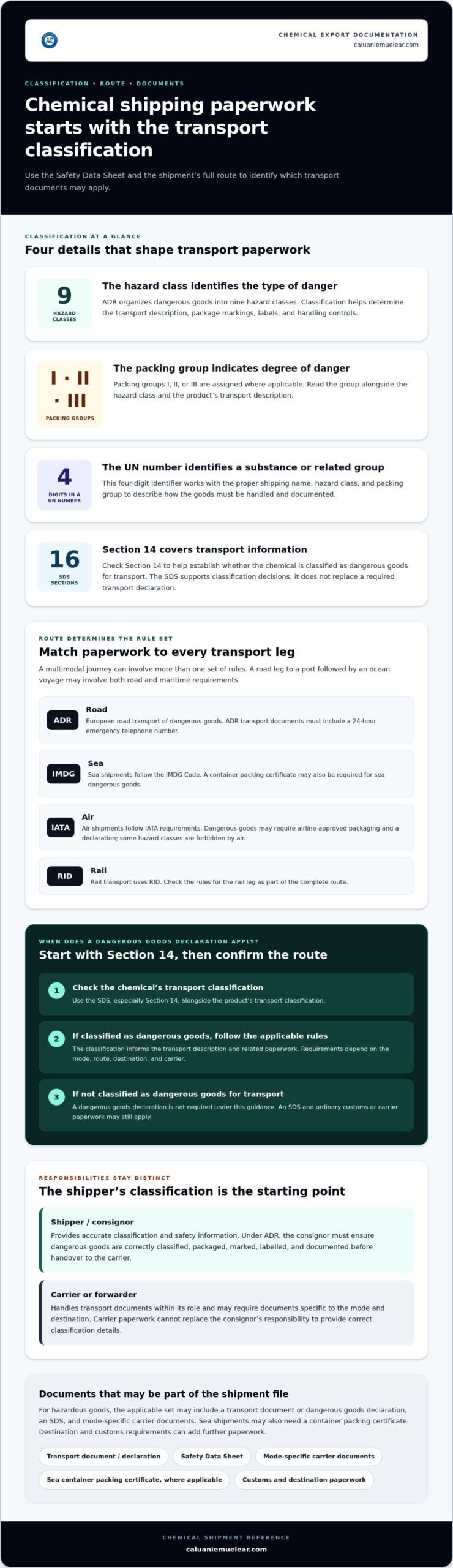
ADR organizes dangerous goods into nine hazard classes, and assigns packing groups I, II, or III where applicable. A UN number is a four-digit identifier for a substance or group of similar substances. Together, these details identify the transport hazard and help determine how the goods must be described and handled.
For example, a shipment description must match the material’s assigned classification, not just its commercial name. The hazard class identifies the type of danger, while the packing group indicates its degree where applicable. These identifiers inform the declaration, package markings, and labels. They also help carriers identify the goods and apply relevant handling controls during road transport.
Safety Data Sheets and Hazard Classifications
A Safety Data Sheet (SDS) is a 16-section document describing chemical composition, hazards, handling, and emergency measures. Section 14 covers transport information, so shippers use it to check whether a chemical is classified as dangerous goods for transport. An SDS supports classification decisions; it does not replace the required transport declaration.
Use the SDS alongside the product’s transport classification when preparing shipment information. If Section 14 identifies dangerous-goods status, the classification determines the applicable transport description and related paperwork. If the chemical is not classified as dangerous goods for transport, a dangerous goods declaration isn’t required under this guidance. The SDS remains useful for communicating hazards, safe handling, and emergency measures, including when transport controls differ from workplace hazard communication.
When Do You Need Chemical Export Documentation?
Required documents depend on the chemical’s transport classification, route, destination, and carrier. Air shipments follow IATA rules, sea shipments follow the IMDG Code, rail uses RID, and European road transport uses ADR.
For air, sea, rail, or road transport, hazardous goods may require a transport document or dangerous goods declaration, an SDS, and mode-specific carrier documents. Sea shipments may also require a container packing certificate. In the United States, OSHA hazard communication and labelling rules apply in workplaces, while EPA requirements apply to certain chemicals; state requirements depend on the chemical and applicable transport rules. For a chemical not regulated as hazardous material, a dangerous goods declaration isn’t required under this guidance, but an SDS and ordinary customs or carrier paperwork may still apply.
Transport Rules and Mode Restrictions
Transport regulations set requirements by mode and route, so one set of documents may not cover an international journey. This matters when cargo transfers between road, rail, sea, or air, because each leg can trigger different rules.
ADR governs dangerous goods transported by road across Europe, while IATA’s Dangerous Goods Regulations apply to air transport. Some hazardous chemicals may travel by air only if they meet applicable requirements, including airline-approved packaging and a dangerous goods declaration; some hazard classes are forbidden by air. IATA rules don’t apply to packages shipped exclusively by ground.
Before booking, match the chemical’s classification to every transport leg. A liquid travelling by road to a port and then by sea must meet the applicable road and maritime requirements. The carrier’s route matters, not just the final destination.
Documents Across Transport Modes
Mode-specific transport documents give carriers the information they need to move hazardous goods and apply safe handling controls. Identify the rules for every leg so a document prepared for one mode isn’t mistaken for the complete set.
For road journeys governed by ADR, transport documents must include a 24-hour emergency telephone number. Sea shipments follow the IMDG Code, and a container packing certificate confirms safe packing of sea dangerous goods. Rail transport is governed by RID. Air shipments use IATA requirements, including a dangerous goods declaration when applicable.
Multimodal shipments combine these obligations rather than replacing them with one universal form. For example, an inland road leg before an ocean voyage may involve ADR and IMDG paperwork. Carriers may also require documents specific to the mode and destination, so the route and cargo classification determine the final set.
Safety Data Sheets and Forwarder Documents
An SDS communicates chemical hazards and safe handling information, while transport documents describe goods for carriage. Keeping these roles distinct helps the shipper provide accurate safety details and the forwarder prepare transport records.
The shipper supplies the chemical classification and product safety documents. The forwarder prepares transport documents using shipment details and the chosen route. Transport documents may include safety information needed for dangerous-goods carriage. The SDS informs hazard decisions but doesn’t replace the transport document.
International shipments may also require customs paperwork. Exporters commonly assemble exporter and consignee details, product descriptions, a commercial invoice, a packing list, and routing information. A customs declaration, such as the Single Administrative Document or its electronic equivalent, may form part of the export file. Shipments between the EU and UK require export and import declarations.
Supply-chain responsibility for shipping documents
Shipping paperwork relies on coordinated information from the shipper, carrier, and other supply-chain partners. Clear responsibility helps keep dangerous goods descriptions, emergency details, and handling instructions consistent.
In the United States, employees preparing hazardous-material shipments need role-appropriate training. The U.S. Department of Transportation requires initial training within 90 days of starting hazmat duties and recurrent training every three years.
Missing or incorrect paperwork can delay a shipment and create safety and compliance risks. Under U.S. DOT rules, knowing hazardous-materials violations can carry fines of up to $80,684 USD per violation.
Roles in Chemical Shipping
The shipper provides accurate chemical classification and safety information, while the forwarder prepares transport documents using shipment details. This division matters because each party controls different information needed for compliant transport.
The carrier relies on transport papers to identify the goods and follow applicable handling instructions. The shipper should ensure product descriptions, quantities, and hazard details match across records. When an industrial shipment changes hands, consistent information is essential, especially for emergency response and package marking. Clear responsibility reduces conflicting paperwork between the shipping floor and the vehicle.
Shipping Controls and Rules
U.S. Cameron University describes DHS Chemical Facility Anti-Terrorism Standards restricting university employees from shipping listed chemicals of interest unless prior arrangements are made and approved by the EHSO. Knowing which framework applies matters because facility security controls and transport paperwork address different risks.
According to Electronic Code of Federal Regulations, U.S. DOT hazardous materials transport regulations are found in part 49 of the Code of Federal Regulations, or 49 CFR. Cameron University describes DHS Chemical Facility Anti-Terrorism Standards as prohibiting university employees from shipping listed chemicals of interest unless prior arrangements are made and approved by the EHSO. Cameron University describes a restriction on university employees shipping any quantity of listed chemicals of interest unless prior arrangements are made and approved by the EHSO. That example concerns university employees and listed chemicals, not every chemical shipment.
Shipping Papers and Shipper Certification
Shipping papers identify dangerous goods for transport and carry information drivers and emergency responders need. Under U.S. DOT rules, they include the proper shipping name, hazard class, UN identification number, applicable packing group, quantity, and emergency response telephone number.
Keep the papers within the driver’s immediate reach or in the driver’s door pocket, as stated under 49 CFR 177.817. Emergency response telephone numbers must be monitored 24/7. The shipper’s certification confirms the shipment information and required preparation are accurate; it doesn’t transfer the shipper’s classification responsibility to the carrier. Check that the declaration, package marking, and shipping paper describe the same goods before handover.
How Do UN Numbers, Proper Shipping Names, and Packing Groups Fit Together?
A UN number identifies dangerous goods, the proper shipping name describes them for transport, and the packing group indicates the degree of danger where assigned. Together, these details connect a chemical’s classification to its packaging and shipping description.
A UN number is a four-digit identifier for a substance or group of similar substances. The proper shipping name is the standardized transport description paired with that identifier. Use both consistently in the declaration and other freight records. A trade name alone may not clearly communicate the regulated transport identity.
The hazard class identifies the type of danger, while packing groups I, II, or III indicate the degree of danger for applicable materials. These identifiers work together: the class describes the hazard, the UN number points to the substance entry, and the packing group informs packaging performance. A mismatch can make the shipping description inconsistent with the package.
Packaging must be UN-approved for the material type and meet applicable safety standards. Its design and performance rating must suit the contents, including the chemical’s properties and assigned packing group. Compatibility matters: a container or closure that reacts with the chemical can compromise containment. Secure closures and inspect packages for damage or leaks before handing freight over.
Packing groups have distinct performance criteria. Packing Group I chemicals require UN-certified packaging rated at 1.8 times the vapor pressure at 50°C. Packing Group II packaging must be rated at 1.5 times vapor pressure at 50°C or 100 kPa minimum. These ratings connect the packing group to the packaging’s tested performance; they don’t replace the need to select packaging compatible with the chemical.
A UN packaging mark provides a useful example of how design and performance details appear together. The mark 1A1/Y1.4/150 describes a steel drum with a non-removable head, approved for Packing Groups II and III, for liquids with specific gravity up to 1.4, and tested at 150 kPa. Read the complete mark against the shipment’s contents and packing group, rather than treating it as a general approval for every chemical.
Before dispatch, compare the UN number, proper shipping name, packing group, and package markings. Confirm that the same identifiers appear across the declaration and transport records. This consistency helps carriers interpret the goods, apply suitable handling, and keep shipping information aligned through import and onward freight. The packaging mark describes the package; it doesn’t replace the chemical’s classification or transport description.
Safety data sheets with chemical shipments
A Safety Data Sheet (SDS) is a 16-section document covering chemical composition, hazards, safe handling, and emergency measures. It supports shipment preparation even when a chemical isn’t classified as dangerous goods for transport. That distinction matters: an SDS communicates product hazards, while a dangerous goods declaration records transport-specific information. One document doesn’t replace the other.
For transport decisions, focus on Section 14. It contains transport information used to assess whether the chemical is regulated as dangerous goods and which transport details apply. Compare the SDS transport information with the product identity and shipping description. If they conflict, the shipment records may describe different substances or hazards. Resolve that inconsistency before preparing labels or transport paperwork.
The SDS also connects manufacturer hazard information with workplace communication. Under OSHA’s Hazard Communication Standard, 29 CFR 1910.1200, distributors provide SDSs and updated information to other distributors and employers with the initial shipment and the first shipment after an SDS update. A distributor may send the SDS with the container or before or at shipment. These timing rules make document control part of shipment readiness.
Check the revision before relying on a stored SDS. A current sheet should reflect the product being shipped, including its composition and hazard information; an outdated version can conflict with container labels or the transport declaration. For chemicals subject to EU requirements, the SDS must reflect the current version of REACH Annex II. Destination markets may also require an SDS in their own language, including some countries in the Middle East, Africa, and Asia.
Keep the SDS accessible to the people who handle the shipment, and align its product identifier with the invoice, packing list, and package labels. For example, a chemical may need workplace hazard labels even when Section 14 doesn’t classify it as dangerous goods for transport. That is why the SDS remains relevant beyond the dangerous goods decision. Its hazard and handling details help distinguish transport rules from workplace communication.
For industrial chemical product information, review chemical product details alongside the applicable shipment paperwork.
Caluanie Muelear Supplier: Caluanie Muelear 1 Liter
Caluanie Muelear Supplier is a practical next step when you’re sourcing Caluanie Muelear for an industrial application. Available options include Caluanie Muelear 1 Liter and Caluanie Muelear Oxidize in 1.5-liter, 10-liter, and 100-liter sizes.
Choose a product and container size that suit your purchasing requirements, then handle shipment preparation separately: classification, route, and destination determine the paperwork. This guidance can help you identify which records apply and how responsibilities are divided across the supply chain.
For product details or purchasing inquiries, visit Caluanie Muelear Supplier.
Plan Your Next Shipment with Confidence
Turn your paperwork plan into a procurement decision suited to the material and its intended use. Treat product selection and shipping compliance as related but separate tasks: the chosen chemical informs the shipment details, while classification, route, and destination determine the documentation process. Keep records aligned from purchase planning through carrier handover.
For sourcing, Caluanie Muelear Supplier offers Caluanie Muelear 1 Liter, Caluanie Muelear Oxidize 1.5Liters, and Caluanie Muelear Oxidize 10Liters. Build the product choice into your planning for chemical shipment documents, rather than leaving product identification until paperwork is being prepared. Clear product details make it easier to keep shipment records consistent across the supply chain.
When you’re ready to discuss these offerings, contact Caluanie Muelear Supplier. Take the next step with your purchasing and shipping plans organized.
Frequently Asked Questions
How Do Different Jurisdictions Work with Regulations?
For chemical shipment documents, requirements depend on where the chemical is produced, transported, and imported. In the United States, DOT rules cover transport, OSHA’s Hazard Communication Standard addresses workplace hazard communication, and EPA requirements apply to certain chemicals. In the European Union, CLP rules govern classification and labelling, while REACH applies to some chemicals. International routes can add destination requirements such as permits, translations, or document authentication.
What Does Shipping Chemicals Internationally Involve?
International shipping typically involves transport paperwork as well as customs and destination documents. Prepare exporter and consignee details, product descriptions, a commercial invoice, a packing list, and routing information. Customs declarations may use the Single Administrative Document or its electronic equivalent. Importers may also need a Certificate of Origin, permits, or legalized documents; some destinations require chemical documents in the local language. Match the paperwork to the route and intended import market.
What Labels and Marks Do Chemical Shipments Need?
Packages carrying dangerous goods need the hazard labels and UN number markings specified for their classification. The guidance identifies a minimum hazard-label size of 100mm × 100mm. It gives minimum UN number marking heights of 12mm, or 6mm for packages of 30L or less. Confirm that package marks match the transport description; vehicle placards apply separately and depend on the goods carried.
What documents are required to ship chemicals in the United States?
For hazardous materials, U.S. chemical shipment documents include shipping papers listing the proper shipping name, hazard class, UN identification number, applicable packing group, quantity, and emergency response telephone number. A shipment may also require an SDS, package labels, and applicable export or customs records. A bill of lading serves as the carrier transport contract. The chemical’s transport classification and whether it crosses a border determine which records apply.
How do I determine a chemical’s DOT hazardous materials classification and proper shipping name?
Start with the chemical’s transport information in SDS Section 14, then compare the substance identity and hazards with applicable transport classification rules. A UN number identifies a substance or group, and its associated proper shipping name supplies the transport description. In the United States, 49 CFR 173.2a sets precedence rules when a material meets more than one hazard-class definition. The shipper is responsible for correct classification before handover.
When is a Safety Data Sheet required for chemical shipments?
An SDS remains relevant even if a chemical isn’t classified as dangerous goods for transport. Under OSHA’s Hazard Communication Standard, distributors provide SDSs with the initial shipment and the first shipment after an SDS update. They may send the document with shipped containers or before or at shipment. Check that the sheet matches the product and market; some countries require SDSs in their own language.
How do I complete a hazardous materials shipping paper or bill of lading?
Use the classification information to enter the proper shipping name, hazard class, UN identification number, applicable packing group, quantity, and emergency response telephone number. Keep these details consistent with the package and transport declaration. A bill of lading also records the carrier transport contract, so shipment parties and routing details should match the consignment. For U.S. road transport, keep shipping papers within the driver’s immediate reach or in the driver’s door pocket.
What are the labeling, marking, and placarding requirements for chemical shipments?
Package labels and marks identify specific dangerous goods, while vehicle placards communicate hazards at the vehicle level. The guidance identifies hazard labels measuring at least 100mm × 100mm and vehicle placards measuring at least 250mm × 250mm. For Table 2 materials, vehicle placards are required when aggregate gross weight exceeds 1,001 lbs. Apply requirements according to classification, package type, and shipment quantity.
 English
 ភាសាខ្មែរ
 Русский
 Tiếng Việt
 한국어
 简体中文
 Қазақ тілі
 ქართული
 日本語
 Deutsch (Sie)
 O‘zbekcha
 Bahasa Melayu
 ພາສາລາວ
Neueste Kommentare