
A chemical’s name and online claims don’t prove what it is or whether it suits your process. That’s the key issue when evaluating oxidizing agents like Caluanie Muelear Oxidize. No verified CAS number, Safety Data Sheet, or manufacturer is established for the named substance here, so claims about its identity and performance require particular scrutiny.
Before making a purchasing decision, compare documented identity, process fit, hazard information, and the purchasing records relevant to your operation. Keep supplier descriptions separate from facts supported by product documents, and note any gaps rather than filling them with assumptions.
This guide applies those criteria to industrial oxidizers, including hydrogen peroxide, potassium permanganate, nitric acid, chlorine compounds, and ozone. It also explains how to distinguish verifiable information from unsupported claims and what to establish before purchasing. Caluanie Muelear Oxidize is among the catalog options, but a product name alone isn’t evidence of chemical identity or suitability.
Key Takeaways
- Compare oxidizing agents like Caluanie Muelear Oxidize using documented identity and process fit, not a product name or marketing claims.
- Use the Safety Data Sheet and product specification for their distinct purposes, and check that the documents are current and apply to the product.
- Define process requirements first, including the target material, required function, and authorized site controls.
- No verified CAS number, Safety Data Sheet, or manufacturer is established here for Caluanie Muelear Oxidize, so claims about it should not be treated as substantiated.
- Use this comparison framework when reviewing the catalog’s oxidizing agents and metal breaking chemicals.
What Industrial Oxidizing Agents Do, and Where Caluanie Muelear Oxidize Fits
An industrial oxidizing agent is a substance that accepts electrons from another substance during a chemical reaction, causing that substance to be oxidized. This describes a chemical function, not a product’s quality, intended use, or suitability for a particular process. The Oxidizing agent reference provides an overview of the concept. Industrial purchasing decisions still depend on product-specific documentation and process requirements.
The term “oxidizer” covers materials with different identities, compositions, properties, and hazards. Sharing a broad chemical function doesn’t make two materials interchangeable, and a trade name doesn’t prove that a product belongs to a particular chemical class. Before comparing options, define the process requirement and identify what the product documentation establishes.
Why industrial buyers compare oxidizing agents
Start with the documented process, not a broad application claim. Identify the intended chemical function, target material, relevant compatibility requirements, and controls authorized for the site. A claim that a product supports metal processing or manufacturing doesn’t show that it fits every material, process specification, or facility.
Keep procurement separate from operation. A purchasing review evaluates identity, documentation, process fit, and supply requirements. It isn’t an operating procedure and shouldn’t be used to infer handling methods or reaction conditions. Those belong in approved site procedures and qualified technical review based on the documented material and process.
What the name Caluanie Muelear Oxidize does, and does not, tell you
Caluanie Muelear Oxidize is a name used in commercial listings, but a name or supplier description is not independent evidence of chemical identity. On its own, it doesn’t establish composition, grade, hazard classification, compatibility, or performance. Those attributes require evidence tied to the specific material being considered.
No verified CAS number, Safety Data Sheet, or manufacturer is established here for the named substance. That documentation gap is not a basis for repeating online claims about its properties as facts. Claims about purity, classification, or industrial effects should remain unverified unless supported by current, product-specific records.
Apply the same evidence-led review to oxidizing agents like Caluanie Muelear Oxidize as to any proposed industrial material. Treat the name as a starting point for document review, not as proof that the material is a recognized oxidizer or a suitable substitute for another agent. Without established identity and relevant documentation, marketing language alone cannot support an assessment of process fit or purchasing suitability.
Keep three questions distinct: what chemical function the process needs, what the product documents establish about the material, and whether that documented material fits the purchasing requirements. This separation helps buyers compare options without confusing a trade name, a chemical function, and a demonstrated application.
Which Evidence Matters When Comparing Industrial Oxidizers?
A reliable comparison starts with records tied to the specific product, not a polished description or familiar-sounding name. Review the exact product identity, composition or grade, intended application, and current documentation. If a record refers to a different product name, supplier, formulation, or grade, it may not support conclusions about the product under consideration.
A supplier claim describes what a seller says; a documented product fact is supported by relevant records, and independent substantiation requires evidence beyond the claim itself. Keep these categories separate in purchasing notes. That way, claims about purity, reactivity, performance, or certification don’t get mistaken for established specifications.
How to read identity and specification evidence
Start by matching the product name and identifiers across the available documents. Check who issued each record, its date or revision, and whether it clearly applies to the material being evaluated. A specification may describe declared limits or characteristics, but those details are useful for comparison only when the measurement method, source, and stated limits are clear.
Be cautious with partial evidence. A supplier webpage, label, photograph, or description of appearance can help identify what is being offered, but none conclusively verifies chemical identity on its own. A specification’s stated value is not automatically independent confirmation that the supplied material meets it. For oxidizing agents like Caluanie Muelear Oxidize, claims about identity, grade, or composition also need product-specific supporting records.
How SDS and GHS information support comparison
An SDS and a product specification serve different purposes. The SDS communicates hazard information and relevant handling and emergency guidance for the product it covers. A specification describes product attributes or limits. Neither replaces the other, and neither should be assumed to apply across products just because their names or broad uses seem similar.
Read GHS hazard classification from applicable product documentation. Don’t infer a classification from a trade name, a general category, or another material’s SDS. If the SDS and product identity don’t clearly correspond, treat the mismatch as an unresolved documentation issue rather than filling the gap with assumptions. Chemical safety data sheets: A practical guide can help readers understand how to review SDS information, but it doesn’t replace product-specific records or site procedures.
For each option, record what the documents establish, what they claim, and what remains unsupported. This makes gaps visible before a purchasing decision advances. The catalog includes Caluanie Muelear Oxidize and oxidizing agents among its industrial chemical offerings.
How Do Caluanie Muelear Oxidize and Other Oxidizing Agents Compare?
A useful comparison separates recognized chemical identities from claims about a particular product. Hydrogen peroxide, potassium permanganate, nitric acid, chlorine compounds, and ozone are established examples of industrial oxidizing agents. Their names alone still don’t establish the grade, formulation, hazards, or suitability of a specific supplied product. No verified CAS number, Safety Data Sheet, or manufacturer is established here for Caluanie Muelear Oxidize. Treat product-specific details as unknown unless reliable documentation supports them.
The matrix below is a screening framework, not a performance ranking. “Unknown” means the available evidence doesn’t support a conclusion. It isn’t a positive or negative finding about a product.
| Comparison criterion | Caluanie Muelear Oxidize | Named industrial oxidizer categories |
|---|---|---|
| Identity evidence | The name appears in commercial listings, but no verified CAS number or manufacturer is established here. | Names such as hydrogen peroxide or ozone identify recognized substances. Verify the identity of the specific supplied product in its documentation. |
| Documented properties | Unknown without reliable, product-specific records. | Product formulation, grade, and stated limits require the relevant specification. Don’t assume them from a chemical name. |
| Intended use | Unknown unless supported by documentation applicable to the product and proposed process. | Assess the specific documented application and process requirements. A broad industry association doesn’t establish fit for every use. |
| Hazard information | Unknown without an applicable, product-specific SDS. | Review the applicable SDS and hazard communication for the exact product. Don’t infer a relative safety ranking. |
| Procurement fit | Cannot be established from a trade name alone. | Compare equivalent grades against process specifications, documentation, and site purchasing requirements. |
Choose criteria that make an apples-to-apples comparison
Compare products only when their documented grades and intended applications relate to the same process requirement. Mark each entry as a documented fact, a supplier statement, or a point requiring independent verification. Product information describes the material; site controls and operating requirements are facility-specific. Keep those categories distinct, and leave a field unknown when evidence is missing.
When an apparent comparison is not valid
Trade names don’t establish chemical equivalence. If identifiers, grades, or documents don’t match, don’t conclude that products are substitutes, safer, stronger, or more effective. Keep operational conditions and reaction instructions out of procurement comparisons. Metal Breaking Chemicals Supplier: A Responsible Buyer’s Guide provides broader purchasing context for this evidence-based review.
This approach keeps claims visible without treating them as proof. For oxidizing agents like Caluanie Muelear Oxidize, make clear what is documented, what is only stated by a supplier, and what remains unknown. That gives procurement teams a defensible basis for deciding whether an option can be assessed further.
How to Match an Industrial Oxidizer to a Documented Process
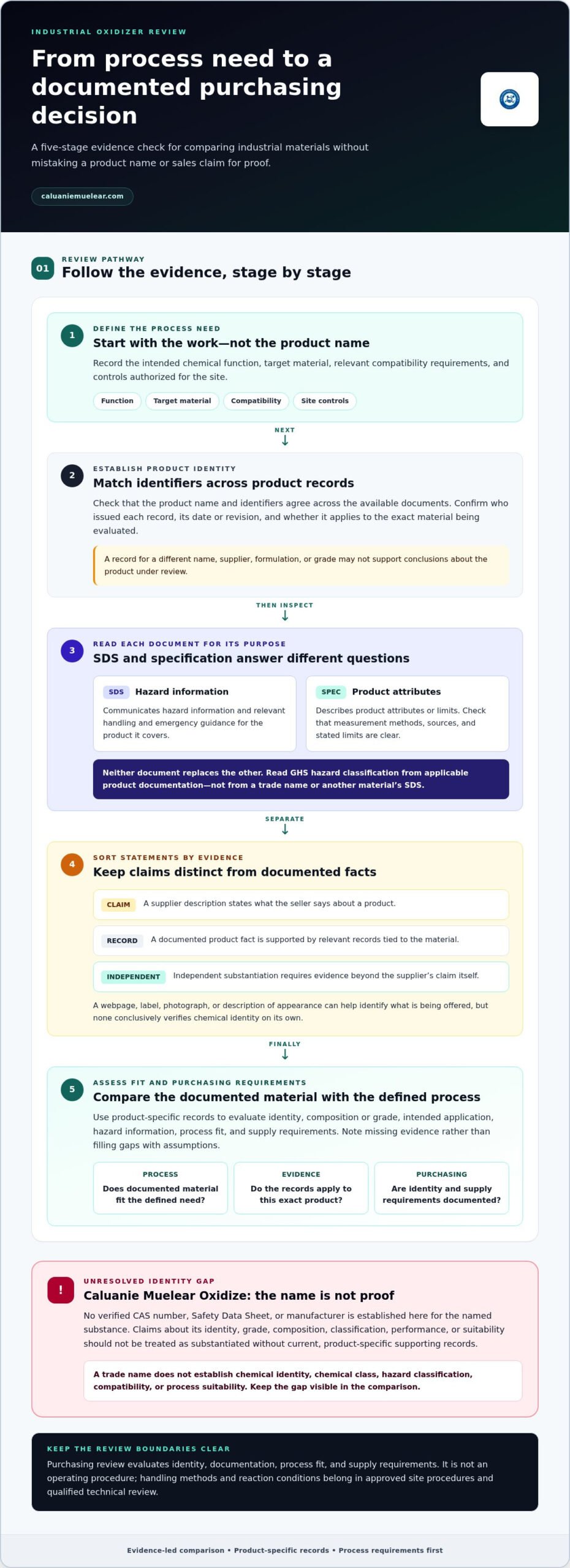
Begin a procurement review with the process, not a supplier’s application language. Define the target material, the chemical function required by the documented process, and the site controls authorized for the work. Then set out the evidence a candidate must provide, including product identity, intended application, compatibility information, and applicable hazard documentation.
Don’t select a product on an application claim alone. A broad statement about industrial use doesn’t establish that a particular product is compatible with a target material or suitable for a specific process. Selection is a documentation and fit decision, not an invitation to experiment. Keep operating procedures and reaction instructions outside this purchasing screen.
A non-operational screening sequence for buyers
Use a written sequence to keep the review consistent. First, record the process specification, target material, required function, and site controls. Next, define the identity, compatibility, and hazard evidence a candidate must satisfy. Then compare the candidate’s product-specific documents against those criteria, noting what is supported and what remains unknown. This workflow evaluates procurement fit only; it doesn’t direct chemical use.
- Define the need. Capture the process requirement and target material as stated in approved site documentation.
- Set evidence requirements. Specify the product identity, intended-use, compatibility, and hazard information required for the review.
- Review the candidate. Match its identifiers and documents to the product being considered, and compare only relevant information.
- Record the outcome. Distinguish documented facts from supplier statements and unresolved points before advancing the purchase review.
When to pause a purchasing decision
Pause if the name, identifiers, or product documents conflict, or if a specification can’t be tied to the candidate. Unsupported claims about purity, certification, compatibility, or performance remain claims, not established procurement facts. Don’t assume a document for a similarly named product applies. Industrial metal breaking chemical procurement: A due diligence guide offers broader purchasing context for reviewing documentation and supplier claims.
This process-fit screen matters for oxidizing agents like Caluanie Muelear Oxidize: a catalog listing identifies a purchasing option, but it doesn’t replace the evidence needed to assess identity, hazard information, or compatibility. No verified CAS number, Safety Data Sheet, or manufacturer is established here for the name. Keep those gaps visible in the decision record rather than resolving them through marketing language.
After reviewing a candidate’s documentation against the process criteria, keep the purchasing decision separate from site authorization and operating procedures. The catalog’s industrial chemical offerings include oxidizing agents and metal breaking chemicals. Use the relevant product listings as a starting point for your documentation review.
Caluanie Muelear Supplier: Product Categories and Responsible Next Steps
A responsible purchasing decision brings the review back to four basics: a defined process need, product-specific identity and specification records, relevant hazard information, and documented fit for the intended application. Keep what the documentation establishes separate from supplier statements, and leave unsupported points unresolved. A catalog entry identifies a listed product option, but it cannot by itself establish chemical identity, equivalence, or suitability.
Where Caluanie Muelear Oxidize sits in the catalog
The catalog includes Caluanie Muelear Oxidize, oxidizing agents, and metal breaking chemicals. Caluanie Muelear Oxidize is listed in 1-liter, 1.5-liter, 5-liter, 10-liter, and 100-liter containers. These are package options, not evidence of a particular specification or process fit. The business describes its industrial chemical solutions as USA-made; that positioning alone doesn’t establish a product’s composition, purity, certification, or performance.
Keep the name in its proper context. No verified CAS number, Safety Data Sheet, or manufacturer is established here for Caluanie Muelear Oxidize. A listing should not be treated as independent confirmation that the named material is a recognized oxidizing agent or a substitute for another chemical. Claims need applicable product-specific documentation before they can support a technical comparison.
What to do before placing an industrial chemical order
Before advancing a purchase, return to the process specification and record what the candidate must satisfy. Match product identifiers and documentation to the specific item being evaluated. Note missing, mismatched, or unsupported details instead of filling gaps with assumptions. Keep the procurement review separate from the site’s safety review and operational authorization. Each serves a distinct purpose, and a product listing doesn’t replace either site-level decision.
- Process need: Confirm the target material and required function against approved process documentation.
- Product record: Compare the candidate’s identity, specification, intended application, and applicable hazard information with the defined requirements.
- Open questions: Keep unsubstantiated statements about identity, purity, certification, or performance marked as unresolved.
- Decision stage: Advance only through the appropriate procurement, site safety, and operational review steps.
This evidence-first approach applies to oxidizing agents like Caluanie Muelear Oxidize and any other proposed industrial chemical. No broad application statement establishes a match for every material or process, and package size can’t answer a technical suitability question. Explore the catalog’s oxidizing agents and metal breaking chemicals, then assess each option against your documented purchasing criteria.
Make Your Next Chemical Purchase Evidence-Led
Turn your comparison into a documented purchasing decision. Record the process requirement, the evidence supporting each candidate, any unresolved claims, and the approvals still needed. This creates a clear handoff between procurement, site safety review, and operational authorization without treating a product description as technical approval.
Use the same standard for oxidizing agents like Caluanie Muelear Oxidize: a name can start a review, but product-specific evidence must support the decision. If documentation leaves a material question unanswered, keep that gap visible and pause before treating the product as a process fit.
Caluanie Muelear Supplier’s catalog includes Caluanie Muelear Oxidize, oxidizing agents, and metal breaking chemicals. Explore the relevant categories and compare product information against your documented requirements.
Explore Caluanie Muelear Supplier’s industrial chemical categories and take your next purchasing step with clear criteria.
Frequently Asked Questions
What is an industrial oxidizing agent?
An industrial oxidizing agent is a chemical used in a process involving oxidation, but the category name doesn’t identify a specific product or prove what it can do. A procurement record should distinguish the requested chemical from its commercial label and connect it to product-specific documentation. The process specification defines the needed function; applicable product information establishes what can responsibly be stated about the candidate.
Is Caluanie Muelear Oxidize the same as other industrial oxidizers?
Equivalence can’t be established from the name alone. Comparing oxidizing agents like Caluanie Muelear Oxidize requires product-specific identity and specification evidence, plus an intended application relevant to the same process. No verified CAS number, Safety Data Sheet, or manufacturer is established here for the Caluanie Muelear Oxidize name. Don’t infer chemical equivalence or interchangeability from similar marketing language.
How can a buyer verify the identity of an industrial chemical?
Match the exact product name and identifiers across the specification, SDS, and purchasing records. Then check whether the documents describe the same product and revision. For example, if a quotation uses a different name from the SDS, don’t assume they refer to the same material. Keep the discrepancy unresolved until the relevant records align. Appearance, packaging, and a supplier webpage alone cannot establish chemical identity.
Does an SDS prove that an oxidizing agent is suitable for a process?
No. An SDS provides hazard and safety information for the product it covers, but it doesn’t demonstrate that the product meets a process specification or will perform as intended. A separate technical review should compare the product’s documented characteristics with the documented process need. Treat the SDS as one part of the purchasing file, not as process approval, and keep site safety review distinct from suitability assessment.
Can two products both described as metal breaking chemicals be compared directly?
Not based on that phrase alone. It’s a broad marketing description, not proof of common composition, grade, hazard information, or performance. A direct comparison is meaningful only when records support comparable products and the same relevant purchasing criteria. If one listing has product-specific documentation and the other relies on a general claim, mark the evidence gap instead of drawing conclusions about interchangeability.
What should a buyer do when product claims conflict with the documentation?
Pause the purchasing review and record the exact conflict, such as a product name on a quotation that doesn’t match the name on its supporting specification. Check whether the documents refer to the same product and revision, but don’t resolve contradictions by choosing the more persuasive claim. Keep unsupported statements about identity, purity, certification, or performance marked as unresolved, and don’t advance the decision until it has a consistent documentary basis.
 English
 ភាសាខ្មែរ
 Русский
 Tiếng Việt
 한국어
 简体中文
 Қазақ тілі
 ქართული
 日本語
 Deutsch (Sie)
 O‘zbekcha
 Bahasa Melayu
 ພາສາລາວ
Neueste Kommentare