
What if the words “metal breaking chemicals” tell you almost nothing about what’s in the container? The phrase isn’t a standardized chemical category, so choosing a metal breaking chemicals supplier by name or dramatic performance claims alone can leave important questions unanswered.
A supplier’s description should match the product and its documentation. Marketing language, however, isn’t proof of chemical identity, intended use, or performance. Before buying, compare the product name and identifiers on the label, safety data sheet, specification, and purchase paperwork. Check that they refer to the same product and fit your application and destination.
This guide explains what the supplier category does and doesn’t establish, which purchasing details deserve careful review, and how to keep a decision traceable. You’ll also learn how to assess broad metal-processing claims and compare package formats. The goal is practical: identify the product, review its records, and make a documented purchasing decision without relying on promotional promises alone.
Key Takeaways
- Assess a metal breaking chemicals supplier by the product-specific evidence behind its claims, not by broad marketing language alone.
- Compare the product name and identifiers across the label, safety data sheet, and specification to spot mismatches.
- Record claims about origin, grade, purity, or application alongside the documents that support them.
- Use a clear purchasing sequence: define the need, identify the product, review its records, and check destination requirements.
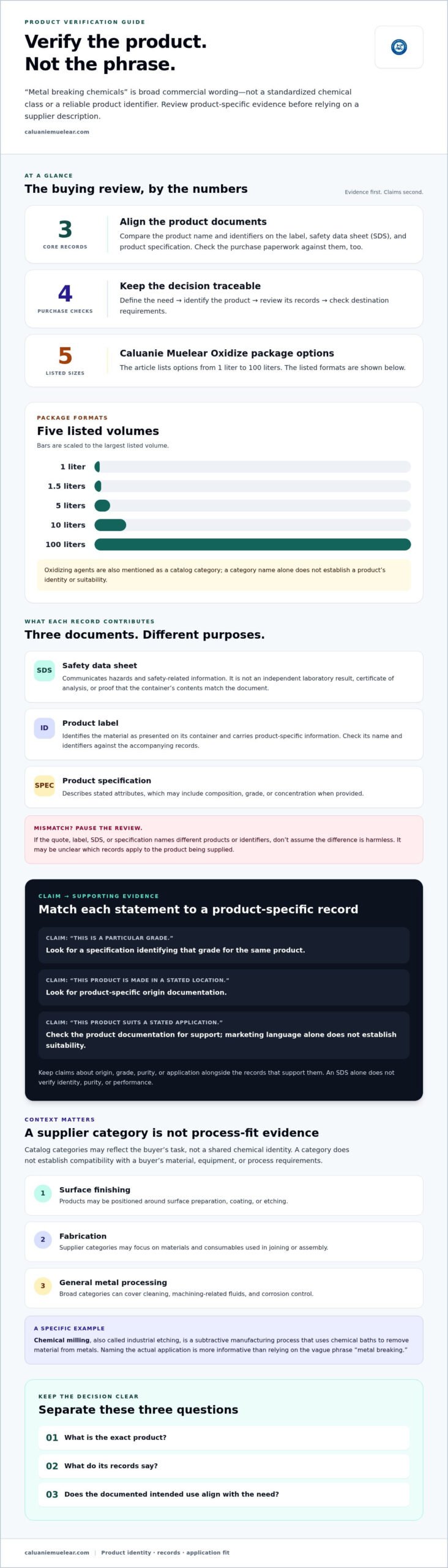
- Explore Caluanie Muelear Oxidize package options of 1, 1.5, 5, 10, and 100 liters, alongside oxidizing agents as catalog categories.
What Does ‘Metal Breaking Chemicals Supplier’ Actually Mean?
The phrase metal breaking chemicals sounds specific, but it isn’t a standardized chemical class or a reliable identifier for a substance. It’s broad commercial wording that may describe different products and claimed applications. A metal breaking chemicals supplier label, by itself, tells you neither what a product contains nor whether it fits a particular industrial need.
Start with the product’s exact name and product-specific records. Compare the identifiers shown on the container and accompanying documents. Don’t infer composition or purpose from a marketing term. A supplier description can explain how a product is positioned, but it doesn’t independently establish chemical identity, efficacy, or suitability for your process.
Does ‘metal breaking chemical’ identify a standardized chemical class?
No. A broad market phrase can group products under one label despite differences in identity, intended use, and supporting documentation. Treat the wording as a search or sales description, not a chemical specification. Look for the product name and identifiers in the relevant records, then check that they refer to the same product being offered.
If the records don’t clearly connect the product name and identifiers, the marketing phrase can’t fill that gap. Claims about what a chemical supposedly does aren’t evidence of its composition or performance.
How supplier categories differ across metal industries
Supplier categories often reflect the buyer’s task, not a shared chemical identity. Surface-finishing suppliers may position products around surface preparation, coating, or etching. Fabrication suppliers may focus on materials and consumables used in joining or assembly. General metal-processing categories can cover varied needs, including cleaning, machining-related fluids, and corrosion control.
These are different purchasing contexts. A catalog category may indicate the market a seller is addressing, but it doesn’t show that a particular product is compatible with a buyer’s material, equipment, or process requirements.
For example, chemical milling, also known as industrial etching, is a subtractive manufacturing process that uses chemical baths to remove material from metals. This established process illustrates why it’s useful to name the actual application rather than rely on the vague phrase “metal breaking.” Surface treatment and fabrication also involve distinct objectives, so a product’s category alone can’t establish process fit.
Before moving toward a purchase, separate three questions: What is the exact product? What do its records say? Does the documented intended use align with the purchasing need? Keeping those questions distinct prevents a supplier’s category description from standing in for product-specific evidence.
Which Supplier Documents Help Clarify a Chemical Product?
Product documents serve different purposes. Review them together, and make sure each one refers to the exact product being purchased. A familiar document title or polished label isn’t enough if the product name or identifier changes between the quote, container, and records.
- Safety data sheet (SDS): Communicates product hazards and safety-related information.
- Product label: Identifies the material as presented on its container and carries product-specific information.
- Product specification: Describes stated product attributes, which may include composition or grade details when provided.
These records help organize the evidence, but they don’t all prove the same thing. Read each for its intended purpose, then compare the product name and identifiers across documents. For a closer look at the distinction, see this guide to SDS vs product specification and what each document can establish.
What an SDS can and cannot establish
An SDS is a reference for understanding the hazards associated with a product and the safety information supplied for it. It is not an independent laboratory result, a certificate of analysis, or proof that the material in a container matches the document. The presence of an SDS alone doesn’t verify identity, purity, or performance.
Use it as one part of a product-specific record set. For broader workplace context, OSHA provides information about toxic metals and their health effects in industrial settings, a relevant resource when considering hazards associated with metal-processing environments.
Why labels and specifications should match the product record
Compare the product name and any identifiers shown on the label, SDS, specification, and purchasing paperwork. If a quote names one material while the SDS names another, or if identifiers conflict, pause the review rather than assuming the difference is harmless. A mismatch makes it difficult to know which records apply to the product being supplied.
Specifications can document stated attributes such as grade or concentration when those details are included. Keep documented attributes separate from promotional statements about origin, purity, or intended application. A sales description isn’t equivalent to a product-specific record supporting its claims.
A simple comparison can make gaps easier to spot:
- Supplier statement: “This product is a particular grade.” Supporting record: A specification identifying that grade for the same product.
- Supplier statement: “This product is made in a stated location.” Supporting record: Product-specific origin documentation.
- Supplier statement: “This product suits a stated application.” Supporting record: Product documentation that describes the intended use.
For a metal breaking chemicals supplier, alignment among the product label, SDS, specification, and purchasing record gives you a more traceable basis for review. Caluanie Muelear Supplier offers Caluanie Muelear Oxidize in multiple package sizes, alongside oxidizing agents and metal breaking chemicals. Review the Caluanie Muelear Oxidize product range as part of your product-specific purchasing assessment.
How to Separate Supplier Claims from Product Evidence
A product page can make claims about origin, grade, purity, or intended application. Treat each as a statement to evaluate, not as proof. To keep the review focused, create a two-column comparison: put the supplier’s exact wording in the first column and the relevant product-specific supporting record in the second. If the evidence column is empty, the claim remains unsubstantiated in your purchasing file.
What counts as a claim, and what counts as evidence?
Promotional phrases such as “high purity,” “industrial grade,” or “suitable for metal processing” are claims unless relevant records support them. Stronger evidence is specific to the product and connected to its identifiers. A dated specification, for example, may document a stated grade or concentration; origin documentation may relate to a country-of-origin statement. Each record should clearly apply to the product under review.
Use a comparison like this:
- Supplier statement: “Manufactured in a stated country.” Supporting record: Product-specific origin documentation that corresponds to the named material.
- Supplier statement: “Meets a stated grade or purity.” Supporting record: A product-specific specification or other relevant quality record that defines the attribute.
- Supplier statement: “Intended for a particular application.” Supporting record: Product documentation that identifies that application or describes the intended use.
A generic company statement may describe a supplier’s overall business, but it doesn’t establish a claim about a specific product or batch. Product-specific paperwork also has limits: it supports only the details it actually states. Don’t assume it confirms other claims that appear nearby in marketing copy.
When inconsistencies should stop a purchasing review
Pause internal approval if the product name or identifier differs across the supplier description, quote, label, and documentation. The same applies when a claimed concentration conflicts with a specification, required records are missing, or two descriptions appear to refer to different materials. Resolve the discrepancy through the appropriate purchasing and documentation process before proceeding.
Appearance can’t close an evidence gap. Color, clarity, or other visible characteristics alone don’t establish chemical identity, purity, quality, safety, or performance. Improvised checks and online photographs aren’t product verification.
For a metal breaking chemicals supplier, a clear review trail is more useful than a confident sales statement. Keep the claim, supporting document, product identifier, and any unresolved discrepancy together in the purchasing record. If no relevant record supports a claim, mark it as unverified rather than treating it as an accepted product fact. This helps procurement teams make consistent decisions without overstating what the available evidence proves.
How to Scope a Responsible Purchase of Metal-Processing Chemicals
A disciplined purchase starts before a product request reaches a supplier. Define the need, identify the product, review its records, and check the requirements that apply to the destination. This sequence gives procurement, technical, and safety reviewers a clear basis for evaluating the request without relying on broad descriptions or assumed performance.
Define the purchasing scope before requesting supply
Write a short, factual brief that identifies the industrial context, the internal purchasing owner, and the exact product name and package format being considered. Describe the intended application at a high level, such as cleaning or surface treatment, without assuming a product will achieve a particular result. Keep the request aligned with your organization’s purchasing, chemical-management, and approval procedures.
Then follow a defined review sequence:
- Define the need. Record the industrial context and identify who owns the purchase and internal review.
- Identify the product. Use its exact product name and requested package format in the procurement request.
- Review product records. Compare the relevant product documentation with the item being considered and note any missing or inconsistent details.
- Check destination requirements. Review applicable rules for the specific product, shipment, and destination before approval.
This process keeps a purchasing brief specific without turning it into a performance claim. A industrial chemical procurement due diligence guide can also help structure the broader review.
Check destination and shipment requirements before approval
Product and shipment requirements can vary by chemical and destination. Don’t assume a product can be purchased, imported, transported, or received under the same conditions everywhere. The relevant review may depend on the product’s documented identity and the destination, so check international chemical shipping requirements as part of internal approval.
Keep this check distinct from the supplier’s marketing description. A statement about an application or product category doesn’t establish that the chemical meets destination or shipment requirements. If your organization needs to verify a particular rule, document the source and date of that review. Avoid applying a general rule to a product or location it doesn’t cover.
Before authorizing a purchase, make sure the internal record connects the stated need, exact product name, package format, reviewed product documents, and destination review. If a key detail is missing or inconsistent, pause approval and resolve the gap through your organization’s procedures. That traceable decision path helps buyers assess a metal breaking chemicals supplier offer using information relevant to the actual purchase.
For buyers considering these product categories, view metal-processing chemical product options as part of a documented procurement review.
Caluanie Muelear Supplier: Product Options and Responsible Next Steps
Product categories and package formats help buyers define what they’re considering, but they don’t establish chemical identity, performance, or fit for a particular process. Caluanie Muelear Oxidize, oxidizing agents, and metal breaking chemicals are product categories offered by Caluanie Muelear Supplier for industrial customers. Treat the application context as a catalog description, then assess the product-specific information relevant to your purchasing decision.
What product and package information can buyers review?
Caluanie Muelear Oxidize is available in these package formats:
- 1 liter
- 1.5 liters
- 5 liters
- 10 liters
- 100 liters
These formats give procurement teams concrete options to include in a request or purchasing record. They don’t indicate which size is appropriate for a particular operation, and package volume doesn’t establish process suitability. Base that decision on your organization’s requirements and the product-specific records under review, not on container size alone.
Caluanie Muelear Supplier supplies USA-manufactured Caluanie Muelear Oxidize. Treat origin as a product-specific claim and review supporting documentation; the statement itself isn’t an independent certification. Keep origin separate from other product attributes, such as grade, purity, intended application, or identity. Evidence for one attribute doesn’t automatically substantiate the others.
Oxidizing agents are another catalog category. The category name alone doesn’t identify a particular substance or establish its characteristics. For any product under consideration, use the exact product name and relevant records to understand what’s being offered. Avoid inferring composition or performance from broad category wording.
A clear next step for an informed buyer
Before making a purchase decision, organize the review around the exact product and the need it is intended to address. Confirm that the product name and identifiers align across the available product information, and review relevant documentation for the specific item. Consider origin, grade, purity, or application statements only to the extent that product-specific evidence supports them. Then apply your organization’s procurement, chemical-management, and approval procedures, including any destination review required for the purchase.
A responsible metal breaking chemicals supplier assessment doesn’t end with comparing catalog labels or package formats. It depends on a clear product record and a purchasing fit your organization can explain and trace. If a claim or identifier remains unclear, keep it unresolved in the review rather than treating marketing language as proof.
For a practical next step, review Caluanie Muelear Supplier’s Caluanie Muelear Oxidize and oxidizing agent options, then compare the product information with the records and requirements your purchasing process calls for.
Make Your Next Purchasing Decision Traceable
A sound purchasing decision should be easy to explain after the order is placed. Build a clear record of why the product was selected, which product information informed the decision, and who approved the purchase. That record gives your team a practical reference for future orders and helps keep procurement decisions consistent as staff or purchasing needs change.
Use the same standard for every metal breaking chemicals supplier you evaluate: distinguish documented product information from claims, and keep unresolved questions visible rather than treating assumptions as facts. A careful process doesn’t need to be complicated. It needs to be consistent, specific, and connected to your organization’s requirements.
Take the next step by reviewing Caluanie Muelear Supplier product information as you prepare your purchasing review. Compare the product options with your requirements and keep the decision grounded in a traceable record.
Frequently Asked Questions
Can a supplier’s product name alone verify a chemical’s identity?
No. A product name helps identify what is being offered, but it doesn’t independently prove what a container holds. Compare the name with the label, safety data sheet, purchase record, and any product or batch identifier provided. If a name appears only in promotional text, or differs across records, treat the identity as unresolved rather than assuming the wording confirms the substance.
Can color or appearance confirm the identity of an industrial chemical?
No. Color, clarity, and other visible features can’t reliably identify a chemical or establish its quality. Two different materials may look alike, while the same product may appear different under varying conditions. Don’t rely on a website image or visual inspection as proof. If identity confirmation is required, follow your organization’s approved verification and chemical-management procedures.
Does an SDS certify that a chemical is suitable for a particular process?
No. An SDS communicates product hazard and safety information; it isn’t a process-compatibility certificate or proof of performance. For example, a document describing a product’s hazards doesn’t by itself show that it’s appropriate for a specific metal or operation. Review process-relevant product information and have the appropriate internal technical and safety reviewers assess it under your organization’s procedures.
Do chemical import and transport requirements vary by destination country?
Yes. Requirements can depend on the product and destination, and transport considerations may differ from purchasing or import requirements. A previous shipment or a general supplier statement doesn’t establish what applies to a new destination. Before approval, check current requirements through the relevant official sources and your organization’s compliance process, using the product identity and destination for the review.
What should a purchasing team do if product documents contain conflicting identifiers?
Pause approval until the discrepancy is resolved. For example, if the purchase request names one product but its accompanying SDS identifies another, don’t assume the difference is harmless shorthand. Record the conflicting details and obtain corrected, product-specific documentation through the procurement process. Keep the correction and updated records with the order so reviewers can trace which information supported the decision.
Can a supplier guarantee that a chemical will work with a specific metal?
A supplier’s guarantee or marketing statement alone can’t establish compatibility or a particular result. Suitability depends on the documented product and the specific material and application. Review what product-specific evidence supports the claim, then have the relevant technical reviewers assess it against your organization’s requirements. A responsible metal breaking chemicals supplier assessment distinguishes documented support from an assurance that lacks a clear basis.
 English
 ភាសាខ្មែរ
 Русский
 Tiếng Việt
 한국어
 简体中文
 Қазақ тілі
 ქართული
 日本語
 Deutsch (Sie)
 O‘zbekcha
 Bahasa Melayu
 ພາສາລາວ
Ulasan Terkini