
What must you establish before a chemical can cross a border? Start with its verified classification, then work through the rules for each transport mode and destination. International chemical shipping requirements are a sequence of linked decisions, not a single document check.
If you’re unsure whether a product counts as dangerous goods or which country’s and carrier’s rules apply, pause before booking. A mismatch between classification, packaging, labels, declarations, or import controls can put a shipment at risk of delay or rejection. One set of instructions won’t necessarily cover every leg: air, sea, and road transport use different frameworks, and destination requirements add another layer.
This practical 2026 guide explains what to establish first and how to build a clear compliance handoff between shipper, carrier, and consignee. You’ll learn how classification and jurisdiction checks shape the next steps, what packaging and paperwork contribute, and where import controls fit in. The goal is to prepare each shipment against the requirements that actually apply, not to rely on assumptions or documents copied from another route.
Key Takeaways
- Establish the substance’s transport classification before choosing packaging or preparing declarations. Don’t assume similar chemicals share the same requirements.
- International chemical shipping requirements depend on the route: air, sea, and road use different frameworks, while destination and carrier rules can add further conditions.
- Use the applicable classification to guide checks for packaging, marks, labels, and shipment documents before tendering the goods.
- Record the classification rationale and keep current document versions together so shipment details can be handed off consistently across the logistics chain.
- Assign clear responsibilities to the shipper, importer, consignee, carrier, and customs participants.
What Determines International Chemical Shipping Requirements?
International chemical shipping requirements are the combined conditions that govern a shipment across its journey. They can include transport regulations, export and import controls, destination-country rules, and a carrier’s acceptance procedures. These layers overlap, but they aren’t interchangeable: meeting a legal requirement doesn’t automatically mean a carrier will accept the cargo.
Start with the product. Its composition and transport classification determine which rules may apply. The origin, destination, route, transport mode, and shipment details shape how those rules are applied. A shipment moving by air and then road, for example, may pass through more than one regulatory framework. Plan for each leg, including transfers and onward transport, not just the international crossing.
Why a chemical’s classification comes before booking
Classification is based on applicable hazard criteria and reliable product information, not on a trade name alone. “Chemical” is a broad product category; “dangerous goods” is a transport-regulatory category for substances that meet specified criteria. A chemical isn’t automatically dangerous goods, and a familiar or non-alarming product name doesn’t prove that it’s exempt. The Dangerous goods classification and regulations overview provides context on how transport classifications and international agreements fit together.
An incorrect classification can send the shipment down the wrong path from the outset. It may affect packaging, documentation, handling, or carrier acceptance, creating safety risks as well as potential delays or rejection. Before booking, base the decision on authoritative product documentation and the rules applicable to the planned shipment. Don’t infer a classification from a similar product or supplier name.
Which parties and rule systems may affect a shipment?
Responsibility is distributed. The shipper provides accurate product and shipment information and prepares the goods for transport. The carrier applies its operating and acceptance conditions. The consignee receives the shipment and may have destination-side obligations. Relevant authorities establish and enforce applicable transport, export, and import controls. Clear handoffs matter because one participant’s approval doesn’t remove another’s responsibilities.
The UN Model Regulations provide a foundation for many dangerous-goods transport rules, but they aren’t a single worldwide shipping permit. Countries and transport modes implement requirements through their own instruments, which can differ in application. Destination checks are separate: a transport classification doesn’t establish that a product may be imported or that all required import procedures have been met.
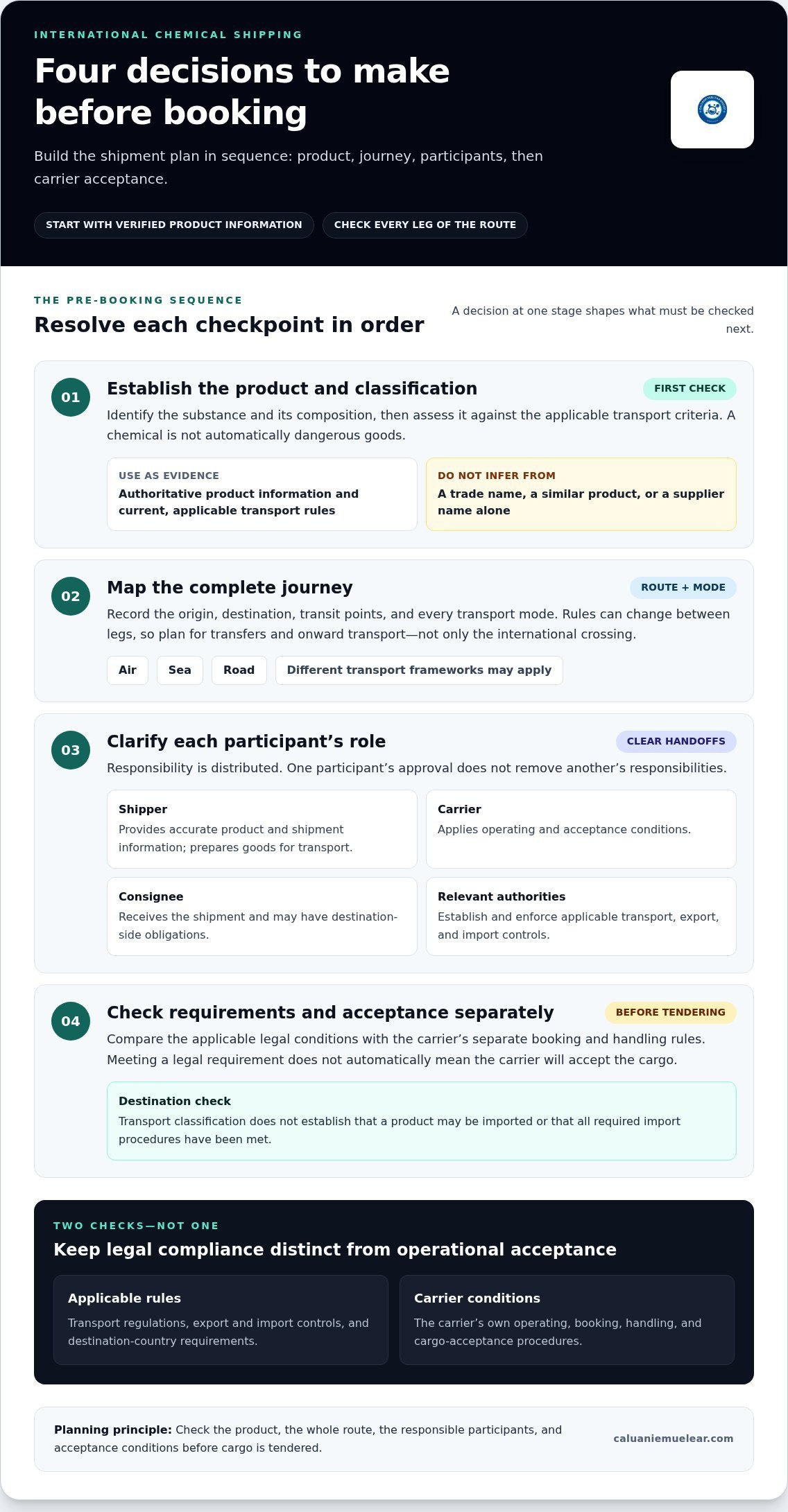
Before committing to a route, map the decisions in sequence:
- Product: Establish the composition and applicable transport classification.
- Journey: Identify origin, destination, transit points, and every transport mode.
- Participants: Clarify what the shipper, carrier, consignee, and relevant authorities need for their respective roles.
- Acceptance: Compare regulatory conditions with the carrier’s separate booking and handling rules.
This sequence separates legal compliance from operational acceptance and helps reveal gaps before cargo is tendered.
How Are Chemicals Classified and Prepared as Dangerous Goods?
Classification comes before selecting transport packaging or completing a dangerous goods declaration. Follow a consistent sequence: identify the substance and its composition, assess it against the applicable transport criteria, then determine the provisions for the specific route and mode. Not every chemical is classified as dangerous goods for transport. The answer depends on the substance’s characteristics and the governing rules, not simply on the fact that it is a chemical.
Product names can help identify an item, but they don’t establish its transport classification. Mixtures, concentrations, physical forms, and other relevant details can affect the assessment. A safety data sheet and technical product records provide important inputs, but classification still needs to be checked against current, applicable transport regulations and authoritative documentation. Don’t assume a classification from a similar material or rely on an outdated document.
What a UN number, hazard class, and packing group mean
A UN number identifies a dangerous-goods entry. The proper shipping name is the standardized transport name associated with that entry. The hazard class describes the type of transport hazard represented, while a packing group, where assigned, indicates a degree of danger within certain classes. These terms work together to describe the applicable transport entry, but packing groups don’t apply to every regulated substance.
For a generic example, imagine a fictional liquid that meets transport hazard criteria. Its confirmed entry would connect a UN number and proper shipping name with a hazard class. A packing group would be included only if the applicable rules assign one. This illustration doesn’t identify or classify any real product. Never fill in these fields by analogy.
How to establish the correct classification
Work through the evidence in order. First, confirm the product identity and composition using reliable records. Next, review the applicable mode-specific transport rules and determine whether the substance or mixture meets a regulated entry or other classification criteria. Then check relevant special provisions, exceptions, or conditions that could affect how the entry applies to the shipment. Recheck if the route, formulation, or governing rule version changes.
- Confirm the product record: Match the exact substance or mixture to reliable composition and technical information.
- Assess transport criteria: Apply the current rules for the intended mode instead of inferring status from a trade name.
- Verify the entry and provisions: Confirm the UN number, proper shipping name, hazard class, and any applicable packing group or special conditions against authoritative documentation.
- Record the basis: Keep the source documents and reasoning that support the classification with the shipment file.
Product identity alone does not establish transport classification. The classification must be supported by composition information and checked against the rules that apply to the shipment. This distinction matters for industrial purchasing, too. Keep product details tied to the exact material and package being discussed so the people preparing and receiving the order work from consistent information. For industrial chemical product information, review the specific product details as part of that record.
How Do Transport Mode and Destination Change the Rules?
A chemical shipment may move through several regulatory environments before reaching its receiver. The international chemical shipping requirements that apply depend on the mode used for each leg, the jurisdictions crossed, and the product and shipment details. Air, sea, and road rules are related, but they’re not interchangeable. Build the compliance plan around the actual route, including transfers and onward transport after arrival.
Air, sea, and road transport: what changes?
Use the comparison below to identify which framework and checks belong to each leg. It’s a planning aid, not a substitute for checking current rules. Limits and packaging conditions can vary with the substance, quantity, packaging configuration, route, and applicable provisions.
| Mode | Framework to review | Operational checks |
|---|---|---|
| Air | ICAO Technical Instructions and the IATA Dangerous Goods Regulations (DGR) | Check the applicable classification, packing and documentation provisions, operator variations, and carrier acceptance for the route. |
| Sea | International Maritime Dangerous Goods (IMDG) Code | Review the relevant code provisions and the carrier’s requirements for the cargo, packaging, declarations, and intended voyage. |
| Road | ADR where it applies to the road segment and jurisdictions involved | Determine which national or regional rules cover each leg, then check applicable handling, vehicle, driver, and document provisions. |
For sea transport, IMDG Code Amendment 42-24 became mandatory on January 1, 2026. Confirm the current edition and any applicable transitional provisions when preparing a shipment. For air, use the relevant ICAO and IATA requirements in force for the planned movement. For road, don’t assume ADR applies identically across every country or segment. Route coverage matters.
No mode is automatically the best fit. A route that combines air and road, for example, requires attention to the applicable requirements for both legs and the transfer between them. Carrier conditions are a separate checkpoint: a shipment can meet regulatory provisions yet fail a carrier’s acceptance rules.
Why destination-country checks are a separate step
Transport classification answers a transport question. It doesn’t settle whether the product may be imported, whether a permit or chemical-control rule applies, or what customs information is needed. Export controls, import restrictions, customs processes, and carrier acceptance are separate checks. Keep each distinct in the shipment plan.
Permission to transport a chemical under dangerous-goods rules is not authorization to import it into the destination country. Before tender, identify the destination’s applicable import controls and customs process, and account for transit countries where relevant. A carrier’s willingness to accept cargo doesn’t resolve an import restriction. Check the product, route, and current jurisdictional requirements together, then pass the findings to the parties handling transport and import.
What Must Be Checked Before a Chemical Shipment Is Tendered?
A shipment is ready for tender only after its classification, route, package, marks, records, and carrier conditions have been reviewed as one connected set. Use this sequence to catch mismatches before cargo enters the transport network. Requirements depend on the product and applicable rules, so don’t copy a checklist from a different substance or route without reviewing it.
- Confirm classification. Use authoritative product information and current rules for the planned transport mode to establish whether dangerous-goods provisions apply and which entry governs. Keep the basis for the decision with the shipment file.
- Map the route. Record the origin, destination, transit points, and each transport mode. Identify relevant jurisdictional requirements for the full journey, including onward movement after arrival.
- Match packaging to the shipment. Packaging must meet the requirements applicable to the substance, its classification, and the transport mode. Check the required package type and preparation against current provisions. Don’t assume a container suitable for one product or route is suitable for another.
- Review marks and labels. Apply marks, labels, and other package information as required by the established classification and applicable rules. Confirm that they are accurate, legible, and placed on the correct package.
- Assemble required documents. Prepare the transport, commercial, and customs records applicable to the shipment. Compare product names, quantities, parties, and route details across them.
- Confirm carrier acceptance. Check the carrier’s current conditions for the specific service and route. Regulatory compliance and carrier acceptance are separate checkpoints; complete both before tender.
Which documents may be needed?
An SDS communicates product hazard and handling information and can support classification review. A dangerous goods declaration may be required to describe regulated cargo for transport. A commercial invoice records the transaction and shipment details, while customs documents support the applicable export or import process. The required set varies by substance, route, mode, and destination. An SDS isn’t, by itself, universal authorization to ship or import.
Keep the records consistent. If a product description, quantity, or consignee differs across documents, that discrepancy can complicate review and handoffs. Broader purchasing checks also support reliable shipment preparation; the chemical shipping compliance due diligence guide connects product procurement diligence with careful documentation.
How to align packaging, marks, and paperwork
Run one final cross-check against the established classification, current official requirements, and the carrier’s conditions. Confirm the package specifications and required marks, then compare the information shown on packages with the shipment records. Resolve inconsistencies before tender, not after a carrier or authority flags them. This makes the handoff clearer for everyone handling the cargo.
For industrial purchasing, start with accurate product details and keep them tied to the exact item being ordered. Review industrial chemical products as part of a well-documented procurement process.
How Can Shippers Build a Reliable International Chemical Handoff?
A dependable handoff makes ownership visible. The shipper coordinates product information and shipment records; the importer and consignee handle destination-side details and receipt; the carrier manages its transport process; and customs participants work with the applicable clearance information. Assign each task to a named role to prevent gaps, duplicated assumptions, and last-minute requests. Keep a shared record of decisions so every participant works from the same shipment version.
A practical handoff sequence for shipping teams
Set the owners before booking: identify who maintains classification rationale, checks destination requirements, prepares records, and communicates with the carrier. Then confirm that the planned route, transport mode, package details, and shipment dates match the information used for those checks. Share current records with the responsible parties before tender, and make clear who will address questions or corrections.
- Open a shipment file. Record the product identity, relevant source documents, route, mode, parties, and planned shipment details. Keep the classification basis with the file rather than relying on an undocumented decision.
- Assign the checks. Name a responsible person for classification records, destination and import checks, document preparation, and carrier booking. Make sure each owner knows what information they need from the others.
- Reconcile the final route. Compare the booked itinerary with the route and modes used during preparation. If a transit point or transport leg changes, pause and determine whether the change affects requirements or records.
- Release records before tender. Provide relevant documents to the carrier, consignee, importer, and customs participants according to their roles. Identify the final versions and retain earlier versions for traceability.
Use clear stop points. Don’t release cargo for tender if product identity or composition information is uncertain, the route hasn’t been checked, required destination details are unresolved, or a necessary record is missing or inconsistent. Escalate the gap to the responsible person and document the resolution before proceeding. These pauses are practical controls, not paperwork for its own sake.
Because international chemical shipping requirements can change with route, mode, and shipment details, retain the version of each document used and note when key decisions were made. If records are revised, identify the current version and distribute it to affected parties. This creates a traceable handoff and reduces the chance that a carrier or receiver acts on outdated instructions.
Where product information supports a responsible purchase
Shipment planning starts with an informed purchase. Buyers need clear product identity and relevant documentation so the shipping team can assess the exact material instead of relying on a broad category or trade name. Caluanie Muelear Oxidize is a catalog product; its mention here does not assign it a transport classification or establish shipping eligibility.
For related sourcing considerations, use the metal breaking chemicals buyer guide as a purchasing reference. Review available industrial chemical product information as you prepare a well-documented order and handoff.
Make Shipment Readiness Part of the Purchase
Before the next order moves forward, build shipment readiness into the purchasing decision. Align the product record, intended destination, and planned logistics early, while there’s still room to resolve missing information. That makes compliance preparation a normal part of procurement, rather than a scramble after an order is placed. Requirements depend on the specific product and route, so tie the decision to the exact material being considered.
Product information is a useful place to begin. The catalog includes industrial chemical products and multiple Caluanie Muelear package sizes, and the business describes its industrial chemical solutions as USA-made. Treat those as purchasing details, not as substitutes for shipment-specific classification or destination checks.
Review product details alongside your planned order and use them to organize the next procurement step. Review Caluanie Muelear Oxidize product information as you prepare for an informed purchase. Start with the product and package details, then build the shipment plan around the exact material and route.
Frequently Asked Questions
Is every chemical classified as dangerous goods for international shipping?
No. A chemical is classified as dangerous goods for transport only if it meets the criteria in the applicable rules. Its chemical nature or industrial use alone doesn’t determine its status. Review reliable information for the exact substance or mixture, including relevant composition and physical form, then assess it against the rules for the planned journey. Don’t infer transport status from a familiar name or similar product.
Can a carrier accept a chemical shipment that the destination country restricts?
A carrier may accept cargo for transport, but that acceptance doesn’t resolve destination import restrictions. Transport acceptance and permission to import are separate matters. If an importer discovers that a restriction or required authorization is unresolved, pause the shipment rather than treating the carrier booking as clearance. The importer or responsible party should resolve the destination-side question through the applicable official process before dispatch.
What information should I have before checking international chemical shipping requirements?
Gather the exact product identity, composition information, physical form, quantity, and packaging details, along with the origin, destination, transit points, and planned modes. Record who will import and receive the goods, too. These details help identify which international chemical shipping requirements need review and prevent a route assessment based on incomplete assumptions. If the formulation or package changes after planning begins, revisit the assessment using the updated details.
Does a safety data sheet authorize a chemical to be shipped internationally?
No. An SDS provides product hazard and handling information, but it isn’t a universal shipping permit, import authorization, or guarantee of carrier acceptance. Use it as one source when preparing a shipment, and compare its product details with the records and rules relevant to the actual route. If the SDS describes a different formulation or outdated product information, resolve the discrepancy before relying on it for shipment preparation.
Can the same chemical shipment documents be used for every country and transport mode?
Not necessarily. A document set prepared for one mode or destination may omit information needed for another leg or jurisdiction. An air shipment followed by road transport, for instance, can involve different transport documentation checks, while customs processes depend on the countries and transaction. Keep product and shipment data consistent, but prepare and update the required records for the specific route, mode, and destination rather than reusing a document set without review.
Who is responsible for checking international chemical shipping requirements?
Responsibility is shared, so assign owners rather than assuming one participant covers everything. The shipper coordinates accurate product and shipment details; the carrier handles its transport acceptance process; and the importer or consignee addresses destination-side requirements within their role. Customs participants need the relevant clearance information. For a practical handoff, name who maintains classification records, checks destination requirements, prepares documents, and confirms the final route before tender.
 English
 ភាសាខ្មែរ
 Русский
 Tiếng Việt
 한국어
 简体中文
 Қазақ тілі
 ქართული
 日本語
 Deutsch (Sie)
 O‘zbekcha
 Bahasa Melayu
 ພາສາລາວ
Yangi sharhlar