
When comparing Caluanie Muelear Oxidize for sale, start with the product information and the quantity your organization needs, not the size of the container alone. Caluanie Muelear Supplier supplies USA-manufactured Caluanie Muelear Oxidize in several listed package sizes, but a volume or origin statement should be considered alongside the product and shipment documentation.
Supplier listings describe 1-liter, 1.5-liter, 5-liter, 10-liter, and 100-liter containers. Those sizes help you compare purchasing options, but they do not establish composition, grade, or suitability for a particular process. Before choosing a size, define the approved procurement need, review the available product information, and plan for the destination and receiving arrangements.
This guide explains how to compare package sizes, review product claims and records, and prepare for a documented purchase. Caluanie Muelear Supplier offers Caluanie Muelear Oxidize and specialized chemicals for industrial applications. Use the product information and applicable requirements to make a considered purchasing decision.
Key Takeaways
- Listed package volumes are 1, 1.5, 5, 10, and 100 liters. Choose a size based on the approved quantity and receiving capacity, not volume alone.
- When reviewing a Caluanie Muelear Oxidize for sale listing, distinguish product and origin descriptions from details documented for the product or batch.
- An SDS, product specification, and batch-specific certificate of analysis serve different purposes. Compare their product names, identifiers, and batch details where available.
- Check current purchasing and shipment requirements with official authorities for the destination and transport route before approving an order.
- Keep the procurement need, selected package size, product records, and receiving plan aligned as you prepare an order.
Caluanie Muelear Oxidize for Sale: Define the Purchase Requirement First
Buyers comparing a Caluanie Muelear Oxidize for sale listing may need to choose a package size, review product information, or arrange receipt at a particular destination. Before comparing options, define the approved procurement need and the information your organization requires to review the product. A product name or industrial-use description helps identify the listing, but should be considered together with the accompanying product records.
This is a purchasing guide, not a use or handling manual. Caluanie Muelear Supplier supplies Caluanie Muelear Oxidize in listed container sizes and describes it as USA-manufactured. Review the product information and shipment details relevant to your purchase, and follow your organization’s approval process and applicable requirements.
What a product listing can establish, and what it cannot
A listing can describe the seller’s offer, including the product name, stated volume, claimed origin, and intended industrial applications. These details help you understand what is being offered. They do not, on their own, establish every product property, batch detail, or suitability for your organization’s specific requirement. Check the product records and the purchase terms alongside the listing.
Different documents answer different questions. A safety data sheet (SDS) provides hazard and safety information for an identified substance. A product specification describes stated properties, while a batch-specific certificate of analysis (COA) reports results for a particular batch. Review the product name and identifiers across relevant records, and check whether batch details match where applicable. The presence of a document alone does not show that every claim in a listing applies to a particular order. For context, Heavy water is a distinct term with its own reference description. A loose comparison or label does not establish that another named product is heavy water or identify its composition.
Pause to resolve missing or inconsistent product, batch, or shipment information before approving an order. A clear review gives procurement and receiving teams a shared basis for matching the purchase to the product information.
Set the purchase criteria before comparing options
Write down the purchasing criteria before reviewing package volumes or preparing an order. Keep them specific to the approved need and your organization’s receiving arrangements.
- Product identity: Record the exact product name and any identifiers used in the relevant product information.
- Approved quantity: Set the quantity according to the documented industrial need and internal authorization.
- Destination: Identify the receiving location and the purchasing and transport requirements that apply to the destination and route.
- Receiving arrangements: Confirm the responsible personnel, internal procedures, and readiness to receive an authorized shipment.
Align these criteria with the documented need before comparing listings. This makes it easier to assess whether a listed package size and the available product and shipment information fit the planned purchase.
Compare Caluanie Muelear Oxidize Package Sizes Against Your Order Need
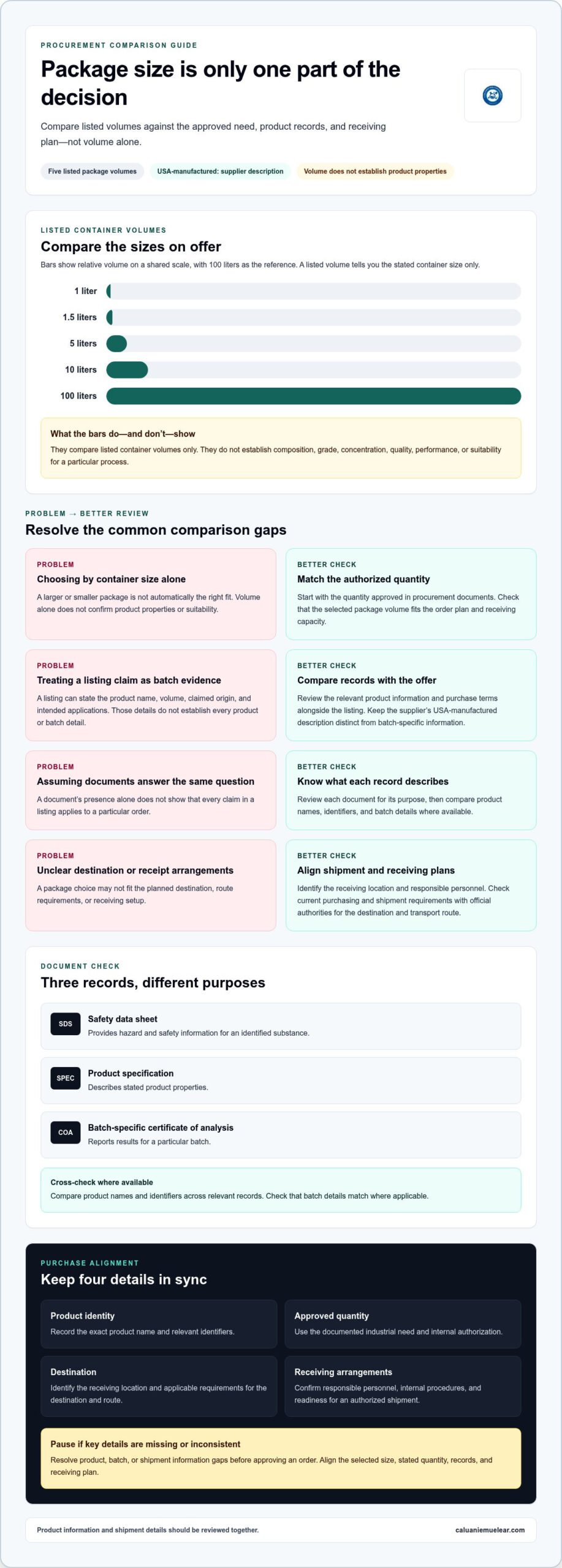
Caluanie Muelear Supplier lists five Caluanie Muelear Oxidize package volumes: 1 liter, 1.5 liters, 5 liters, 10 liters, and 100 liters. Compare those options with the quantity approved for your purchase and your organization’s ability to receive the shipment. Volume alone does not establish composition, quality, concentration, or performance.
The table summarizes the listed package sizes. Use it to identify the volume that corresponds to your procurement plan, then review the product information and order details before making a decision.
| Listed container volume | What the volume tells you |
|---|---|
| 1 liter | The stated container volume only |
| 1.5 liters | The stated container volume only |
| 5 liters | The stated container volume only |
| 10 liters | The stated container volume only |
| 100 liters | The stated container volume only |
How to choose among the listed container volumes
Use the quantity authorized in your procurement documents as the starting point. Then consider whether the selected package volume suits your organization’s receiving capacity and order plan. A smaller container is not automatically the right fit, and a larger one is not automatically more suitable. Do not infer value or product properties from volume alone.
The company lists the product in the sizes shown above and describes its supply as USA-manufactured. Keep that origin description distinct from batch-specific product information when reviewing an order. Match the selected size, stated quantity, and product details across your purchasing records.
What to compare when reviewing a price quote
A price figure is one part of a quote, not a substitute for reviewing the product and order details. This guide does not provide prices, market averages, or savings estimates. Check that the quote describes the same product and container volume as the option you are considering. Review the listed terms, including any applicable freight, taxes, and destination-related charges, and make sure the quoted quantity matches the approved order.
An online marketplace entry, including Caluanie Muelear Oxidize product information, is a source of product claims, not a replacement for reviewing the details relevant to your purchase. Compare names, identifiers, package volume, and batch information across the listing and applicable records. If quote terms or product details conflict, resolve the discrepancy before moving forward.
Check Product Identity and Supplier Claims Before You Buy
Review product information in a consistent order: match the stated identity, examine the available records, compare claims across documents, and resolve discrepancies before approving a purchase. Promotional descriptions, origin statements, and document formats each have a role, but should not be treated as interchangeable evidence. The goal is to ensure the records you use for procurement refer to the same product and, where applicable, the same batch.
- Match the identity. Compare the exact product name and any stated identifier across the listing and relevant documents.
- Review the records. Note the supplier, batch reference, document dates, and whether each record applies to the product being offered.
- Compare claims. Check whether statements about origin, grade, purity, or performance are supported by relevant product information.
- Resolve discrepancies. Address differences in names, identifiers, dates, or batch details before completing the purchase.
- Keep a record. Retain the product and order information used for internal review and receiving.
Review identity and batch records without assuming a marketing name is proof
Compare the product name across the listing, specification, SDS, and any batch-specific COA provided for review. Check that the supplier, batch reference, and dates are consistent where those details appear. A COA should identify the batch it reports on; a generic or undated document does not show that its results apply to a particular batch.
If a CAS Registry Number is supplied, compare it with the specific material described in the product records using an authoritative chemical reference. A number printed on a page or certificate should be reviewed in context with the other information. Do not use appearance, touch, or improvised chemical tests to identify a substance. Those are not substitutes for reliable product records and appropriate verification.
Separate safety information from sales specifications
An SDS communicates hazard and safe-handling information for an identified substance. It is not, by itself, a product specification or a batch-specific quality report. A product specification describes stated properties, while a batch-specific COA reports analytical results for a particular batch. Review each document for its intended purpose and compare the information that applies to the purchase.
GHS hazard communication and OSHA requirements may be relevant frameworks, but applicability depends on the transaction and jurisdiction. Check current requirements with the appropriate official authority rather than assuming a document’s format establishes compliance. If an SDS names a different substance, a COA lacks a matching batch reference, or a claim has no corresponding information in the relevant records, pause to resolve the issue before relying on that claim.
Prepare a Compliant Caluanie Muelear Oxidize Shipment and Receiving Plan
Plan a shipment as part of the procurement process, not as a separate assumption based on a general delivery statement. Shipment requirements can depend on the product’s identity, destination, route, and applicable transport rules. Before approving an order, review the shipment details and confirm that the receiving organization is prepared to accept it.
For a documented chemical purchase, use a clear sequence: confirm current destination and route requirements, review the applicable transport information, assemble the required records, verify receiving arrangements, and complete internal order approval. If a required product detail, classification, or permission is unresolved, pause the purchase until the issue is addressed.
Check destination and transport requirements before placing an order
Import, transport, and purchasing requirements may vary by destination, route, and material. Check current requirements with official authorities responsible for the destination and relevant transport route. Do not assume that information for one country, carrier, or shipment applies to another.
Use product identity and classification information relevant to the purchase when determining which requirements apply. Where current rules require consignee qualifications, permits, or supporting records, include them in the procurement plan. If the product information or applicable transport requirements are unclear, resolve those points before arranging the shipment. A general delivery statement does not replace a review of destination requirements.
Make sure the receiving organization is ready
Before an authorized shipment, align the purchase paperwork with the receiving plan. Confirm internal approval, identify the designated consignee, and follow the organization’s process for accepting and recording the delivery. Dispatch alone does not mean the receiving process is complete.
Make it possible for the receiving team to match the shipment to the approved purchase order and relevant product or batch records. A mismatch in product name, quantity, consignee, or batch reference should prompt a hold and review rather than an informal correction after arrival. Keep delivery estimates and general shipping statements separate from confirmation that the organization’s receiving checks are complete.
Caluanie Muelear Supplier distributes regulated industrial chemical compounds to verified purchasers. Include the applicable shipment records and receiving arrangements in the order review, and make sure the purchase follows current requirements for the destination and route.
Choose a Caluanie Muelear Oxidize Purchase Option and Take the Next Step
A considered procurement decision follows a clear sequence: document the need, select a listed volume that fits the approved quantity, review product and shipment information, check destination requirements, and obtain internal order approval. Keeping those steps together helps procurement and receiving teams work from the same order details.
Caluanie Muelear Supplier lists Caluanie Muelear Oxidize in 1-liter, 1.5-liter, 5-liter, 10-liter, and 100-liter containers and describes the supply as USA-manufactured. Compare the package sizes against your approved need, then review the product information relevant to the option you select.
Use a final purchase-readiness checklist
Before approving an order, use this checklist to catch mismatches and keep a clear record of the decision:
- Document the need: Confirm the requested product and quantity are tied to an approved industrial procurement record.
- Match the listed volume: Ensure the requested container size aligns with the approved amount and the organization’s receiving capacity.
- Review the records: Gather relevant product documents and shipment details for internal review, then compare names, batch references, quantities, and consignee information where applicable.
- Check the destination: Verify current purchasing and transport requirements with the appropriate official authorities for the destination and route.
- Separate claims from records: Keep the supplier’s product and origin descriptions distinct from batch or shipment information used in the purchase review.
If essential details are missing or inconsistent, keep the order on hold until they are resolved. A checklist helps organize the review, but it does not replace the product information and approvals required for the purchase.
Move from comparison to a documented order
Buyers can explore Caluanie Muelear Oxidize options and review the supplier’s listed package sizes and origin description. Use the listing to compare the available purchasing options, then align the selected product and quantity with the records required for your order.
Before completing a purchase, ensure the product name, package volume, quantity, and shipment details match your procurement plan. Keep the relevant product information with the order records so the receiving team can refer to the same details. This makes the transition from comparing options to placing a documented order clear and organized.
Make Verification the Next Step
A listing helps you understand the product and package sizes offered. A careful review goes further: compare the product details with the records relevant to your purchase, confirm the selected volume suits the approved quantity, and account for destination and receiving requirements.
Caluanie Muelear Supplier lists five container sizes and describes its supply as USA-manufactured. Use those details to identify the option that fits your procurement plan, while reviewing product and shipment information as part of the order process.
Review the listed Caluanie Muelear Oxidize options and choose a package size that matches your documented purchasing need. Start your order with Caluanie Muelear Supplier by selecting the appropriate listed option and completing your organization’s procurement review.
Frequently Asked Questions
Is Caluanie Muelear Oxidize a standardized chemical name?
Caluanie Muelear Oxidize is the product name used in the supplier’s listings. A commercial name alone does not provide every detail needed for a specific purchase. Review the product information and any identifiers supplied, and compare them with authoritative chemical references where appropriate. If a name and identifier appear inconsistent, resolve the discrepancy before relying on the information for procurement.
Can a product listing prove the identity of a specific batch?
A listing describes the supplier’s offer, while batch-specific details belong in records that identify the batch. Compare the product name, supplier, batch reference, and document dates across the listing and relevant product records. A product photograph or general specification may not identify a particular batch. Keep the order review focused on records that correspond to the product and batch being purchased.
How much Caluanie Muelear Oxidize should a buyer order?
There is no universal quantity that suits every purchaser. Set the amount according to your organization’s approved procurement records and receiving capacity. Caluanie Muelear Oxidize is listed in 1-liter, 1.5-liter, 5-liter, 10-liter, and 100-liter containers, so compare those package volumes with the authorized quantity. A listed size alone does not determine whether an order is appropriate for your need.
How much does Caluanie Muelear Oxidize cost?
This guide does not provide a price or market range. When reviewing a quote, compare the product description, container volume, quantity, and stated order terms. Check whether applicable freight, taxes, and destination-related charges are itemized, and make sure the quote corresponds to the option you intend to purchase. A price alone does not describe the product or the full terms of an order.
What should buyers verify before shipping Caluanie Muelear Oxidize internationally?
Before arranging an international shipment, check current import, transport, and purchasing requirements with official authorities responsible for the destination and route. Review the product records, applicable shipment information, and consignee details for the transaction. Requirements may differ by jurisdiction, so do not treat a general delivery statement as confirmation that every requirement has been met.
Are the 1-liter and 1.5-liter options the only available package sizes?
No. Caluanie Muelear Supplier lists 1-liter, 1.5-liter, 5-liter, 10-liter, and 100-liter containers. Compare those package volumes with your approved quantity and receiving capacity. Volume alone does not establish composition, grade, performance, or suitability, so review the product information relevant to your purchase as well.
 English
  ភាសាខ្មែរ
  Русский
  Tiếng Việt
  한국어
한국어  简体中文
简体中文  Қазақ тілі
  ქართული
  日本語
日本語  Deutsch (Sie)
  O‘zbekcha
  Bahasa Melayu
  ພາສາລາວ
Recent Comments