The strongest option isn’t automatically the right one. Choose a metal breaking chemicals supplier by matching the product’s stated application to your process, then weighing product information, packaging, and shipping requirements. This gives you a practical basis for comparing options before ordering.
It’s easy to focus on a chemical’s name or a bulk container and overlook whether it suits the job. Compare product details, plan packaging and shipment requirements, and avoid assuming a broad label proves suitability. The key is to match the option to your application and purchasing needs.
The guide also explains why product variety matters: the right selection depends on the application, the amount needed, and how the material will be handled. Use these points to narrow your choices and move toward a more informed purchase.
Key Takeaways
- Compare chemicals by the metal and process they’re intended for, not by product name alone.
- Plan packaging and shipping around the quantity needed, handling requirements, and receiving setup.
- Avoid purchasing mistakes by defining the application and reviewing product information before ordering.
- Use supplier offerings and package sizes to narrow options, then match the selection to your operational needs.
Bulk packaging, shipping, and order timing
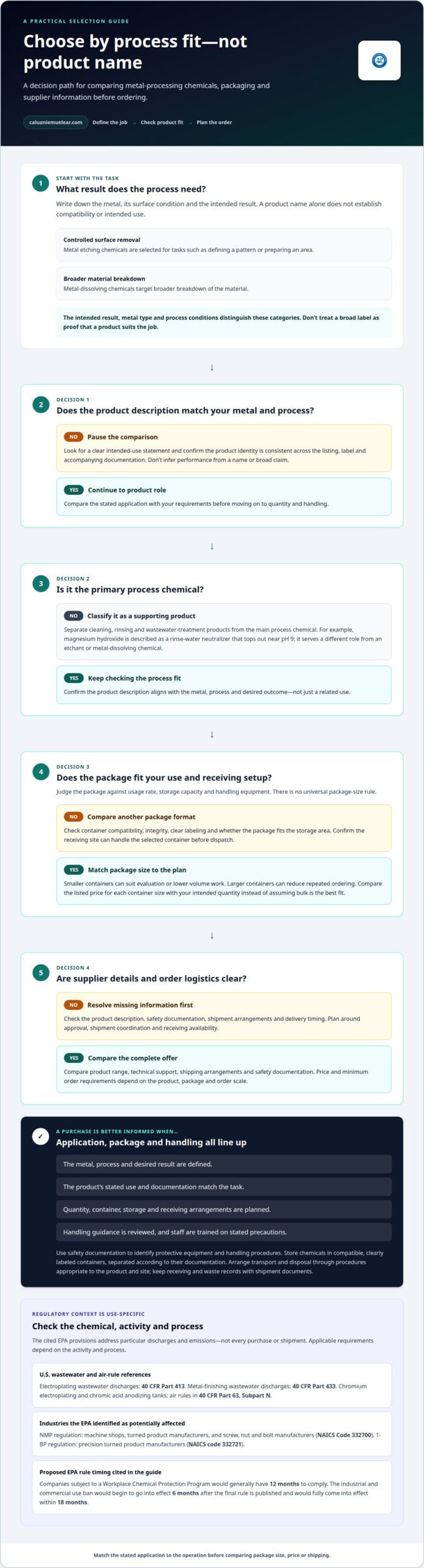
Compare suppliers by product range, technical support, shipping arrangements, and safety documentation. Match each option to the metal, process, and quantity your operation needs. Then compare packaging formats, container compatibility, shipment handling, and delivery timing. A clear written product description helps prevent ordering a chemical for the wrong application. Confirm that the receiving site can handle the selected container before dispatch.
Bulk packaging should match usage rate, storage capacity, and handling equipment. Smaller containers can suit evaluation or lower-volume work; larger containers can reduce repeated ordering. These are planning considerations, not a universal packaging rule. For product packaging, check container integrity, clear labeling, and whether the package fits your storage area. Plan order timing around approval, shipment coordination, and receiving availability.
For corrosive chemicals in the United States, applicable requirements depend on the activity and process. U.S. electroplating wastewater discharges are subject to EPA effluent guidelines in 40 CFR Part 413, according to the U.S. Environmental Protection Agency. U.S. metal-finishing wastewater discharges are subject to EPA effluent guidelines in 40 CFR Part 433, according to the U.S. Environmental Protection Agency. Chromium electroplating and chromic acid anodizing tanks are covered by EPA air rules in 40 CFR Part 63, Subpart N, according to the U.S. Environmental Protection Agency. These provisions address discharges and emissions, not every purchase or shipment.
For proposed EPA rules, companies subject to a Workplace Chemical Protection Program would generally have 12 months to comply, according to the U.S. Environmental Protection Agency. The ban on industrial and commercial uses would begin to go into effect 6 months after the final rule is published and would come fully into effect within 18 months, according to the U.S. Environmental Protection Agency. Build compliance planning around the specific chemical and use.
Price and minimum order requirements depend on the product, package, and order scale. Compare the listed price for each container size with your intended quantity rather than assuming a bulk order is the best fit. Review product information and handling guidance before purchasing.
Use the product’s safety documentation to identify required protective equipment and handling procedures. Train staff on the stated precautions before opening containers. Store chemicals in compatible, clearly labeled containers, separated according to their documentation. Arrange transport and disposal through procedures appropriate to the product and site. Keep receiving and waste records with the relevant shipment documents.
Chemical product variety
Chemical names alone don’t tell you how a product acts on metal. Metal etching chemicals are selected for controlled surface removal, such as defining a pattern or preparing an area. Metal-dissolving chemicals target broader breakdown of the material. The intended result, metal type, and process conditions distinguish the categories.
Start by defining the task. Is the goal surface marking, material removal, or processing metal for another operation? Record the metal, the surface condition, and the desired result. Then compare product descriptions against those requirements. A product suitable for one metal or process may not suit another, so don’t treat broad labels as proof of compatibility.
Product variety also includes chemicals used around the main process. For example, magnesium hydroxide is described as a rinse-water neutralizer that tops out near pH 9. It serves a different role from an etchant or metal-dissolving chemical. Separate process chemicals from cleaning, rinsing, and wastewater-treatment products when comparing options. This prevents a related-use chemical from being mistaken for the primary process material.
Consumer and business availability isn’t a separate chemical formula category. It depends on intended use, labeling, package format, and applicable sales restrictions. Consumer-facing products are oriented to defined small-scale applications; business purchasing considers the industrial process, material, volume, and documentation needs. Compare stated uses and package details rather than assuming one product suits both settings.
Before selecting a product, use this sequence: identify the metal, state the required surface or material outcome, and distinguish the main process chemical from supporting products. Then compare descriptions for intended application and handling information. If you’re evaluating options in this category, review the range of metal breaking chemicals as one part of that comparison. Product variety matters only when it aligns with the actual operation.
Regulatory context can also shape product comparisons. The EPA identified machine shops, turned product manufacturers, and screw, nut, and bolt manufacturers (NAICS Code 332700) as industries potentially affected by NMP regulation. The EPA identified precision turned product manufacturers (NAICS code 332721) as an industry potentially affected by 1-BP regulation. These industry references can help when checking whether a product’s stated use and documentation fit the operation.
Chemical selection and purchasing mistakes
A sound purchase starts with a defined process outcome. Write down the material, its condition, and the intended result before comparing products. For example, marking a steel surface differs from processing metal for another purpose. Treating those tasks as interchangeable can lead to an unsuitable purchase. Product names alone don’t establish compatibility or intended use.
Compare each product description with your actual application. Look for a clear intended-use statement and product identity that stays consistent across the listing, label, and accompanying documentation. Don’t infer performance from a name or broad claim. Pay attention to any mismatch between the listing and container information before ordering.
Common purchasing errors include:
- Choosing by name alone: Match the stated use to the material and process, not a dramatic product label.
- Ignoring the target metal: Record whether the job involves steel, aluminum, copper, or another material.
- Ordering without a process plan: Define the intended result and how the chemical fits the operation.
- Overlooking packaging: Check that the selected container suits the planned quantity and receiving setup.
Review documentation as carefully as the product description. Compare the chemical name and intended application across product information and shipping paperwork, and keep those records with your order. This creates a reference if shipment details appear inconsistent. Don’t rely on informal claims that lack matching written information.
Before placing an order, use a short review sequence: confirm the target metal, define the process outcome, compare product information, and match the package to the operation. Then review handling and safety documentation alongside the order details. A metal breaking chemicals supplier should be evaluated on clear product information and consistent documentation, not confident wording alone. These checks reduce preventable selection errors without assuming one chemical suits every material.
Which suppliers sell chemicals for breaking down or dissolving specific metals?
Industrial chemical distributors and specialty process-chemical suppliers are common starting points. Their catalogs may cover metal breaking, etching, or dissolution products, but those labels don’t establish suitability. Give the supplier the exact metal, the intended process, and the desired result. A request involving copper surface removal differs from one involving steel breakdown.
Supplier fit depends on the match between the product’s stated application and your operation. Ask for product information identifying the chemical and its intended use. Compare that information with your material and process requirements. A general-purpose description isn’t enough to determine whether a product applies to aluminum, copper, steel, or an alloy.
Separate material-specific requirements from broad product claims. A supplier may list metal breaking chemicals without specifying every compatible metal or process. Don’t infer compatibility from a category label. Instead, define the material, its condition, and the result you need, then compare those details with the product information before ordering.
Compare suppliers using the same criteria. Review whether product descriptions are clear, chemical names are consistent across product information, and documentation corresponds to the item being offered. Look for direct information about intended applications. Vague claims or inconsistent records make comparisons difficult and can lead to selecting the wrong product.
A metal breaking chemicals supplier is most useful when its product information distinguishes metal processing from etching and surface preparation. Keep the decision focused: define the material, state the process goal, and evaluate each product against those specifics. This makes comparisons more meaningful than choosing by catalog wording alone.
For a sourcing starting point, explore metal breaking chemical options and compare their stated category with your operation’s requirements.
Corrosion describes metals breaking down into chemically stable compounds, including metal oxides, metal sulfides, and metal hydroxides. This is different from a broad product label: corrosion refers to a type of breakdown, not confirmation that a particular chemical suits a specific metal or operation. Keep that distinction in mind when comparing products and their stated applications.
Caluanie Muelear Supplier: Caluanie Muelear 1 Liter
Caluanie Muelear Supplier offers several packaging options for readers comparing metal breaking chemicals. The range includes Caluanie Muelear 1 Liter and Caluanie Muelear Oxidize 1.5Liters, 10Liters, and 100Liters.
Treat package size as one purchasing consideration alongside your planned quantity and storage arrangements. A smaller container may suit a different need than a bulk container, so choose according to your operation rather than size alone. Keep the product name and package size clear in your online order details.
Contact Caluanie Muelear Supplier to discuss the listed options for your sourcing needs.
Turn Your Selection Into a Clear Next Step
Before ordering, prepare a concise purchasing brief. Record the intended application, the material involved, the selected product, and the package size. Share those details with the person responsible for receiving and handling the shipment. This keeps the purchasing decision connected to the operation and makes order details easier to review.
Choose a metal breaking chemicals supplier that fits the requirements you’ve defined, rather than reshaping the job around a product label. Use your brief to keep the selection focused and make the next step clearer. Review Caluanie Muelear’s product options online and place your order through the website.
For your next step, contact Caluanie Muelear Supplier about its chemical offerings. You’re ready to move forward with a clearer basis for your purchase.
 English
 ភាសាខ្មែរ
 Русский
 Tiếng Việt
 한국어
 简体中文
 Қазақ тілі
 ქართული
 日本語
 Deutsch (Sie)
 O‘zbekcha
 Bahasa Melayu
 ພາສາລາວ
Свежие комментарии